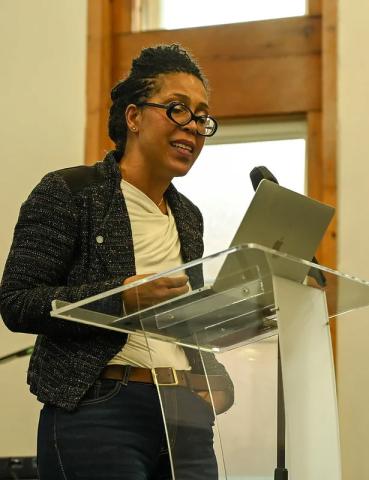
Johanna Fernández, brilliant scholar/activist and valued member of S&D’s editorial board, died on July 30, 2026. She was only 55; she was felled by an aggressive cancer that had struck her five years earlier. Her passing is a great loss to all who knew her as well as to the wider movement to which she gave her energy.
I met Johanna fifteen years ago, in the context of political work on behalf of Mumia Abu-Jamal. Her film about Mumia’s case, Justice on Trial, came out in 2010 and was instrumental in upending the official narrative on Mumia (which supported the 1982 death sentence against him). She joined our editorial board soon after. Together with Mumia, she edited and introduced S&D’s special November 2014 issue (28:3; #66), The Roots of Mass Incarceration in the US: Locking Up Black Dissidents and Punishing the Poor. The issue was presented publicly to an audience of over two hundred at the Audubon Ballroom; its print-run was sold out. The following year saw the release of Johanna’s edited collection of eighty essays by Mumia, entitled Writing on the Wall.
Johanna’s magnum opus is The Young Lords: A Radical History (2020) – an in-depth study of the short-lived but powerful Puerto Rican organization that arose in the late 1960s and, like the Black Panther Party, blended community activism with revolutionary vision. She noted in many of the Young Lords the experience of being the first in their families to grow up in the United States, taking on the role of mediating between their parents’ generation and their own – an experience that paralleled her own as the child of recent immigrants from the Dominican Republic (following the 1965 US invasion of that country). Her book, rich in interviews, received exceptionally wide acclaim.
In 2023, Johanna completed the arrangements for all the personal papers of Mumia Abu-Jamal to be archived in the library of her alma mater, Brown University.
The last project Johanna brought to fruition was a series of exhibitions and conferences on the Latino role in US history, occasioned by the 250th anniversary of US independence. As co-curator of the series, she spoke from her home base at the City University of New York at the opening event (in April 2026) of the multi-city display. The series highlights “the pivotal role Latinx communities played in shaping social justice movements of the 1960s and 1970s, while connecting these struggles to a longer historical arc.”
Unfinished at the time of her death was a projected book-length study of fascism, of which she provided a foretaste in a 2021 article, “On the Historical roots of U.S. Fascism”, which, drawing on an earlier study in S&D, locates those roots in the post-Reconstruction period of US history, when the Southern plantation oligarchy sponsored a reign of terror to undo the recent steps toward racial equality.
Johanna Fernández was at once a peacemaker and a fighter. She championed unity among those with revolutionary aspirations but at the same time was focused, relentless, and tireless in her opposition to the oppressor. She was an inspiring speaker and teacher, and a splendid team worker. We have a responsibility to keep her work and her example alive.