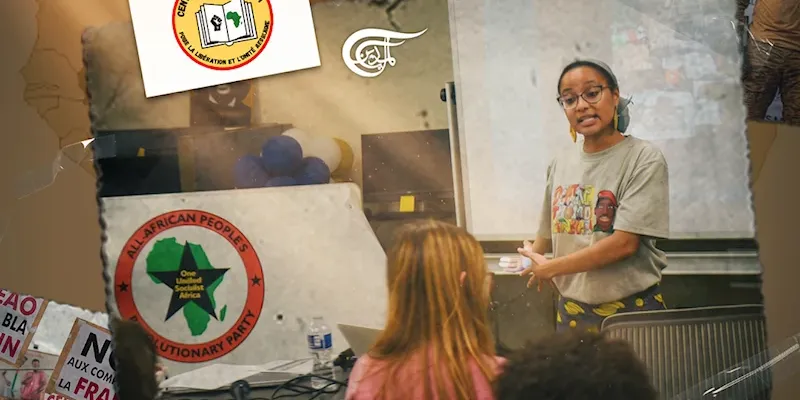
Rosa Moro visits the Thomas Sankara Centre in Ouagadougou, exploring how a grassroots project rooted in Pan-Africanism, anti-imperialism, socialism and women’s emancipation has grown into a hub for political education amid the Sahel’s wider anti-imperialist mobilization.
The Thomas Sankara Centre in Ouagadougou, Burkina Faso, is about to celebrate its fifth anniversary. It was established in October 2021, before the current government came to power on September 30, 2022.
Its founders describe it as "a Pan-African library and centre for political and ideological education," guided by four fundamental principles inspired by Thomas Sankara’s ideology: Pan-Africanism, anti-imperialism, scientific socialism and the emancipation of women.
The library offers a free lending service and contains works that are difficult to find anywhere in the region and that, generally speaking, are neither readily available nor accessible to the population.
The Centre also runs other projects, such as study-and-work circles and the “Young Pioneers” programme for children, as well as organising a wide range of activities. Once a month, for example, they screen films dealing with geopolitics that can help viewers gain a better understanding of a current event or situation. They have screened films about the Democratic Republic of Congo, Sudan, Haiti… After each screening, a discussion is held, with someone from the country or territory concerned joining online to answer questions.
There are several study-and-work circles that meet weekly. Each group selects a book - not just any book, but works such as Class Struggle in Africa by Kwame Nkrumah. Participants read a chapter at home and then discuss it at the Centre. The rest of the meeting is devoted to geopolitical discussion. Each day, a different person proposes a current-affairs article or video, which then serves as the starting point for a discussion of what is happening, always from a revolutionary and Pan-African perspective.
As for the “Young Pioneers”, the project draws on an initiative from 1985, during Sankara’s time, called “Pioneers of the Revolution Programme”. The Centre has launched something similar: groups of children who learn about the history and culture of their own communities and of Africa, guided by a comrade who himself was a Young Pioneer in 1985.
When Inem Richardson and Wendlassida Fabrice Simporé turned their dream of founding a centre of this kind in Burkina Faso into reality, they did not know how it would work. Almost five years later, the Centre is thriving. Its activities and events attract huge numbers of people, and it has an ever-growing number of members and supporters. It has become so popular, not only in Burkina Faso but throughout the region, that they have opened a centre in Niamey, Niger. In 2023, they even had the honour of meeting President Ibrahim Traoré when their young pioneers performed the pioneer salute for him at the Thomas Sankara Memorial on 15 October, the anniversary of Sankara’s assassination.
I had the opportunity to visit the Centre and speak with Inem, whose Burkinabè name is Baowendsome. There, I was able to see for myself that the revolution is not a project involving a handful of Burkinabè people: the revolution is happening in real time. As a European, alongside the emotion, I also felt an enormous amount of envy.
Whose idea was it to establish the Thomas Sankara Centre (CTS)?
It was mine and Comrade Fabrice’s. Basically, we both had the idea of providing some context for everything that is happening.
When I was at university in the United States, I was more interested in academic research, but I was also involved in the anti-imperialist struggle. I was part of an anti-imperialist organisation focused on Latin America called the Chiapas Support Committee and later joined the All-African People’s Revolutionary Party (AAPRP), which I am still a member of. In fact, everyone here at the CTS is part of the AAPRP.
I had spent some time in Senegal, where I could see that an anti-imperialist movement was emerging in the Sahel region. There was a high level of political awareness: you could hear people talking about anti-imperialism in the streets. And it wasn’t just Senegalese people. While I was in Dakar, I met people from Mali, Burkina Faso, and other parts of the region. That is where Fabrice and I met.
The initial idea behind the CTS was to gather important books and make them available to people. But Fabrice wanted to do it in a physical space where people could meet, so he found this place in Ouagadougou, and we started! The project immediately began to grow and grow, and people started joining us.
While I was in Senegal, I had this feeling … “something is going to explode in this region”, and I wanted to understand what was happening here. I moved to Burkina Faso in 2021. I believed that this country had enormous revolutionary potential, but I could never have imagined that everything would happen so quickly! It was incredible.
What resources do you have? How do you fund yourselves?
Incredibly enough, all of our day-to-day operations are funded through crowdfunding and international solidarity. We have a GoFundMe and Patreon. We do a lot of fundraising on social media, and socialist, Pan-Africanist and communist organisations, as well as people involved in the anti-imperialist struggle around the world, subscribe to our Patreon. They may give us as little as five dollars a month, but it all adds up.
I should make it clear that we have a very good relationship with the current government, but it does not fund us. It is international solidarity that makes it possible for the CTS to operate.
In my view, the strong anti-French sentiment means that people are not looking closely enough at the real source of today’s imperialist brutality: the United States and NATO. What do you think?
A few years ago, I was genuinely concerned about this. I saw that there was an almost exclusive hyper-focus on France, but I truly believe that this has changed. More and more people are becoming critical of US imperialism and aware of NATO.
Niger was the first country to cut its cooperation with AFRICOM. Eritrea is the only country in Africa that has never had agreements with AFRICOM, and Niger is the first to break that chain. This was the result of a popular movement: there was enormous popular mobilisation not only against France, but also against the United States.
I think that in recent years we have seen a clearer understanding of the role of the United States. I can give you some examples.
When General Michael Langley of AFRICOM made disparaging remarks about Ibrahim Traoré, there were numerous demonstrations outside US embassies in different places. They were massive.
When, a year ago or more, Human Rights Watch began accusing the Burkina Faso army of carrying out massacres and abuses against the population, people protested outside US embassies because they knew that the United States was behind these false narratives. Some members of our Centre took part in the demonstration outside the US embassy in Ouagadougou and spoke to people who said they understood that France is more visible, "but we also understand that France does not act alone and that the United States is behind it."
That understanding was beginning to spread, and today there is a stronger anti-NATO sentiment. There are even posters and graffiti denouncing NATO.
Another example of the fact that people understand more than can perhaps be perceived from outside is what is happening in Bobo-Dioulasso, the second-largest city in Burkina Faso. In front of its major university, Nazi Boni, there has been a huge mural since last year denouncing terrorism. The painting depicts three terrorists whose faces are, respectively, the French, American, and Ukrainian flags.
Now with Donald Trump’s second term and the havoc he has wreaked on Burkina Faso’s allies– Venezuela, Cuba, Iran, etc.-- the anti-imperialist movement in Burkina Faso is fighting US imperialism even harder. The contradiction has become crystal clear. There is no more ‘American dream.’
What do you think is behind this change, this social awakening?
I think that, for some time now, in the current geopolitical context, people have been forced to become sharper.
For example, Ibrahim Traoré, Assimi Goïta and Abdourahamane Tchiani have all had relations with Maduro’s Venezuela and with the Cuban Revolution. This forces people to understand what is really happening in Venezuela or Cuba in a different way. Now that we are paying so much attention to Sankara’s policies, people are gaining a better understanding of other revolutions. We are seeing a more openly globalised form of imperialism, and these parallels can be observed. When Nicaragua opened an embassy in Burkina Faso a few years ago, people barely knew the country. Now there is an interest in the Sandinista Revolution, in North Korea; even what is happening in Palestine is being viewed from an anti-imperialist perspective.
Of course, our governments’ strong relationship with Russia also plays a role. It is making people think about imperialism from different points of view and become more aware.
I have to say that the masses here are quite conscious. There are, of course, different levels of awareness, but people have a strong anti-imperialist and anti-colonialist base, and this is widespread. People in the most remote rural areas may not talk to you about NATO or Maduro, but they are very clear that they are fed up with France and that Europe has done nothing good in Africa.
Even in the most remote places, there is a strong Pan-African sentiment. For example, people understand that the borders we have inherited are a legacy of colonialism and that our peoples want to live together rather than divided.
Even compared with other African countries, I see the level of anti-imperialist consciousness in Burkina Faso as greater and more widespread.
Is it the same in Niger and Mali?
I think so. I think Burkina Faso, Mali, and Niger are currently at the centre of African anti-imperialism.
It is true that Ibrahim Traoré is the most charismatic of the three leaders and the one with the better communication, but the anti-imperialist struggle taking place in Mali and Niger is extremely significant and important.
In some ways, I think Niger does not receive enough recognition. It is the only country that has placed US imperialism at the centre of its struggle at the level of official state policy; it is the only one to have confronted AFRICOM head-on.
For example, Niger has one of the largest uranium deposits in the world and has nationalised its uranium sector from France’s state-owned company Orano.
I think Burkina Faso is ahead when it comes to transforming people’s material conditions through industrialisation and food sovereignty, and also because of its leaders and because of the way the population organises itself on a mass scale, for example through the citizens’ vigilance groups (Veille citoyenne/ les Wayiyans) and the Volunteers for the Defence of the Homeland (Volontaires pour la défense de la patrie). But the progress being made in Niger and Mali is also very important.
Mali is also making major efforts in partnership with Russia, with which it is also working to develop nuclear and solar energy. It is also fighting to gain greater control over its gold mines and has challenged several major companies operating there, such as Resolute Mining and Barrick Gold.
I think all three are achieving things in one area or another. Every advance made by one of the three is an advance for all of them, and vice versa, every attack by imperialism against one of them also harms the other two. They are united, and they know that imperialism never stops.
Finally, let’s talk a little about Western NGOs.
People have absolutely no trust in some of the major NGOs, such as Human Rights Watch or Amnesty International, because of the narratives they have been spreading about us around the world for some time. People here do not take them seriously; there is a great deal of scepticism.
Honestly, one of the things I have been hearing for some time here is that many foreign NGOs have supported terrorism or that they somehow serve as a means of laundering money. For example, when terrorists control a red zone, where even the army has difficulty gaining access, NGOs enter without any problem! That raises a lot of alarm bells. People believe that, under the guise of providing aid, they are all working towards the same goal.
People have many questions about Western NGOs: Who are these people? What are they bringing in? How do they get into these areas?
I would also say that there is still a major problem in Africa with this kind of “white saviour” mentality. It is very unfortunate.
We need to look back to the era of Sankara. The peoples of Africa will be free when they themselves carry out the struggle for liberation, unite, and build something new based on their own culture. Africa will not be free because Westerners come with handouts. That is not how it works.
Finally, it is important to point out that NGOs have played a very important role in Africa in terms of destroying revolutionary ideology. They draw people away from the revolutionary context.
For example, the struggle for women’s equality during the Sankara era was integrated into the revolution. The idea was that the revolutionary process involved raising women to positions of equality. As I told you, one of the CTS’s values is the emancipation of women.
And this is an area where we clash with certain NGOs, because they take that struggle out of its revolutionary context. They have “NGO-ised” the struggle, and this creates a backlash among the population, which now opposes it because it perceives it as something coming from Western NGOs.
We are working to bring these struggles back into the revolutionary context. There is no other way.
Thomas Sankara, Samora Machel, Ahmed Sékou Touré, and so many others incorporated the emancipation of women into their liberation struggles, and those projects were - and remain - very different from what Western NGOs propose.
Read the original at Al Mayadeen English.