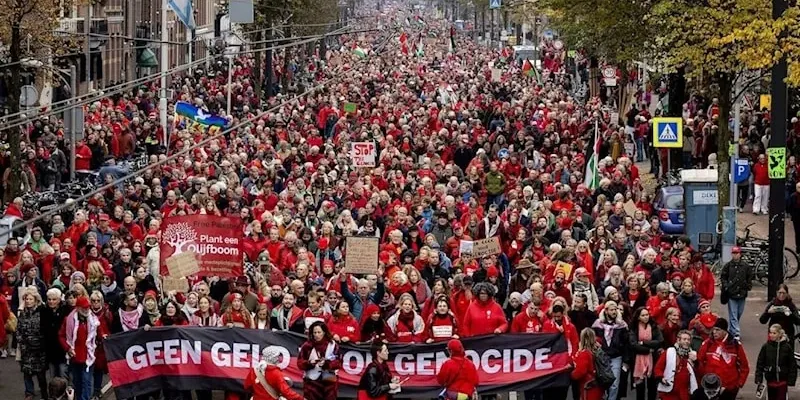
More than 200,000 people took to the streets in Amsterdam to show solidarity with the Palestinian people and demand that the government sever diplomatic and economic ties with “Israel”, Nov. 2026. (@ultras_antifaa / X)
Amsterdam’s “red line” protest drew a huge crowd on Sunday, as pressure grows on the Netherlands to follow France and Belgium in recognizing Palestine.
The Netherlands has yet to join France and Belgium in formally recognizing a Palestinian state, and on Sunday a huge crowd in Amsterdam demanded that its government go further in confronting "Israel".
Dressed in red, demonstrators filled the city’s streets in what organizers called a “red line” protest. Police-independent estimates were not given, but the organizers put turnout at around 200,000, while reports described the crowd as tens of thousands. Many held placards condemning genocide in Gaza.
Steven Eisinger, a 33-year-old robotics engineer born in the United States, was among those marching, a red scarf around his neck. He told AFP he wanted Dutch arms shipments to "Israel" to end. Eisinger, who is Jewish and has relatives living in "Israel", said he was there to voice his backing for Palestinians and his opposition to genocide.
Government under pressure
Prime Minister Rob Jetten took part in a comparable demonstration in 2025 while still seeking a seat in parliament. Speaking to journalists on Friday, however, he said joining this one would be “inappropriate” given his current office.
The government has taken some steps already. In late September, it prohibited imports of goods made in Israeli settlements on occupied Palestinian land, which international law regards as illegal.
Israeli Foreign Minister Gideon Sa'ar responded by withdrawing the accreditation of Dutch diplomats. Separately, the Netherlands has pulled out of next year’s Eurovision Song Contest, with broadcaster NPO pointing to the “sensitive” question of "Israel’s" participation.
Meanwhile, Gaza remains in a severe humanitarian crisis, Israeli aggression continues on a daily basis, and attacks by settlers on Palestinians in the occupied West Bank have grown more frequent.
Read the original at Al Mayadeen English.