Can a selective reading of history sustain a global order whose legitimacy is increasingly being questioned? (Illustrated by Fatima Attieh for Al Mayadeen English)
From Rome’s wars against Persia to today’s confrontation with Iran, history reveals a far more complex reality than the myth of an eternal clash between “the West” and its enemies.
In the absence of any positive political vision, Washington and its surrogates are doubling down on their fictitious links to the ancient past.
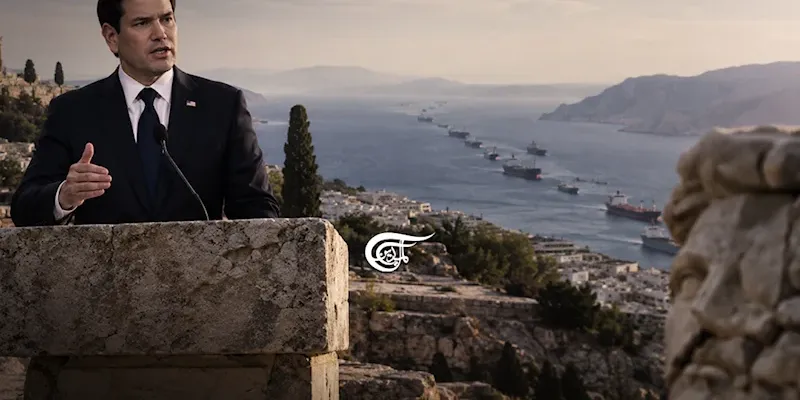
US Secretary of State Marco Rubio’s October 7 speech from the Athenian pnyx, framed by the Parthenon atop the ancient Acropolis, was markedly lacking in subtlety, even by the standards of American and European politicians.
Acting as if the ruins themselves might imbue his words with the gravity they so clearly lacked, the address was less oratory and more a rambling whine insisting on a continuous unbroken thread connecting Classical Greece and Rome with contemporary North America and Europe. He pled that ‘the West’s’ present sense of stagnation and directionlessness is due to the critical reevaluation of the historical record, such as the Atlantic slave trade and the nature of the British Empire. It was an insistence on the continued preeminence of the Western cultural tradition- by which we can infer he meant free-market capitalism and the kind of cultural chauvinism born of half a millennium of overt white supremacism. By implication, his thesis - to the extent he and his ilk have one - is that the general decline in public acceptance of these systems is itself the cause of their weakening.
On some level, he is correct. The declining acceptance of the innate superiority of Euro-American political, economic, and cultural systems by the rest of the world naturally entails the decline of their influence. But the solution of the Western chauvinist never extends further than the demand that the world should return to venerating the West as innately superior. There is rarely any examination of why global opinion no longer takes this superiority for granted, or how Western actions themselves contribute to its loss of ideological legitimacy.
Half a month out from the US mid-term elections, it should be clear enough where this lack of subtlety is coming from. US diesel prices are at their highest levels on record as a direct result of the Trump administration’s Israeli-incited war of choice against Iran- levels that will only continue to worsen for the foreseeable future. The compounding crisis in the Strait of Hormuz, eight months on, is continuing to plough through the arteries of the global economy- fueling a systemic crisis of a magnitude unseen since the Great Depression of the 1930s. Rather than address the US (and his own personal) role in causing this crisis, it is simply easier for Rubio and his kind to rally the support of the Hoi polloi around myths of their own abstract ‘greatness,’ and similarly abstract connections to the vanished glories of Greece and Rome.
The West as convenient fiction
For all of their supposed veneration of the Western historical experience, neither Rubio nor any other ideologue within the US regime cared to consult the records of the 23 Roman emperors who attacked the Persians -under the Parthian and Sassanian regimes- of whom Iran is the direct modern continuation. Had any of them done so, they might literally have avoided the present crisis, having learned the futility of these campaigns, which, along with many being crushing defeats, economically bled the Roman state. This then set the stage for its disintegration at the hands of the barbarians of Europe and its near extinction by the Arab conquerors of the seventh century.
Rubio did clearly know enough to cite the Persian sack of Athens under the Achaemenids as evidence of an eternal enmity between Iran and “the West.” Here at least, he shows some actual continuity with the ancient tradition he seeks to appropriate. Iran was the original designated ‘eternal enemy’ of the Greeks (and later the Romans) who would retroactively come to constitute “the West” in the European imaginary, many centuries later. In doing this, he attempted to elevate the US-Israeli war from the level of an illegal aggression to an existential, metaphysical and fated struggle between the North Atlantic world and the Islamic Republic. Here again, this is the simpler and easier pivot to make, despite bearing little resemblance to reality.
While the rulers of the Greco-Roman world enthusiastically painted the Iranians as representing everything abhorrent to their culture, this in no way implied solidarity with the “barbarians” of Northern Europe, whose descendants now posture as its direct inheritors.
The categories of ‘Europe’ and ‘European’ did not even begin to exist until the Early Middle Ages when used as distinctions from the Arab conquerors, the ‘Moors-Saracens.’ Even here, the labels applied to western lands subject to the Catholic Church, certainly not to the surviving Roman state in Constantinople, with whom there was a mutually held contempt that culminated in the Frankish sack of the Eastern capital in 1204 during the Fourth Crusade.
The Eastern Romans themselves saw very little in common worth acknowledging with Western Europe and did not consider themselves “Western” in any recognizable modern sense.
Seldom in these ideological games did the “Eastern Other” also use the distinction to define itself in opposition to the West. Neither the Iranians nor the later Islamic Ummah conceived of its opponents as its eternal, metaphysical enemy. Even the Roman-Persian conflict, upon transforming into the Arab-Byzantine wars of the early Middle Ages, from the Eastern perspective was rooted in the belief that they were the rightful inheritors of Roman sovereignty, not its destined destroyers. It was on this basis that the eventual conquerors of Constantinople, the Ottoman Sultans, styled themselves “Caesars of Rome” in the centuries following 1453AD.
In its present guise, “the West” did not truly begin to emerge until well into the modern era, when the competing colonial powers of Europe were deep into their decline, ceding global leadership to the United States. It could be legitimately argued that “the West” as we know it did not become a politically meaningful concept until the Cold War, wherein it functioned as the umbrella of political alignment with Washington.
Since the collapse of the USSR and the self-evident unravelling of Liberalism as the underpinning ideology of global politics, this narrow, largely ahistorical rhetoric about “the West” is all Washington has left to legitimize its dominance. Dominance that it is ironically squandering with some of the exact mistakes of the extinct civilizations it imagines as its originators.
Read the original at Al Mayadeen English.