Introduction
A specter has been haunting U.S. workers—the specter of weakening worker voice, massive union decline, precarious employment, unprecedented growth in economic inequality, and the decline of American democracy. These are the core contours of the “Second Gilded Age” and its associated political inequality (e.g., Bartels, 2008). Symptomatic of this great transformation, the strike, once the major tactic in the labor movement’s repertoire of contention, is now much less frequent and much less efficacious (Rhomberg, 2012: 268; Rosenfeld, 2014: Chapter 4), the recent militancy upsurge notwithstanding (Isaac, 2023). In short, the complex of forces that have given us the Second Gilded Age are responsible for blunting the strike as means to collectively dissent to the power of employing capital.
The conventional narrative of the long-term historical trajectory of the strike in America periodizes as follows: (i) during the original Gilded Age transformation to industrial capitalism strikes grew in frequency, size and effectiveness in open over wages, hours, control of work rules, support of other striking workers, and union recognition (see U.S. Commissioner of Labor 1888); (ii) the mid-1930s New Deal turn to the institutionalization of collective bargaining ushered in the legal regulation of the strike by the state and the National Labor Relations Board (NLRB) from the 1930s through the 1970s; here strikes still took place with great frequency but were more rule-driven, tied to contract expirations, and institutionally contained; and (iii) the current period began to emerge by the 1980s producing a precipitous decline in the house of labor, breaking the bargaining table (Rhomberg, 2012), and with it, the weakening and decline of the strike. During this current period, scholars and labor activists have discovered the role of the public sphere and civil society as they desperately look for ways to strengthen labor’s hand. Consequently, strategic moves have resorted more frequently to public relations and discursive opportunities along with extending worker struggles deeper into the community and appealing for wider support of conscious constituencies in search of allies.
There is much that is true in this standard narrative. However, the image of civil society and public sphere’s importance found only in the current period of labor-capital contestation but not previous periods, should be questioned. What stands out in the long view is not the deviation of the current period, but rather the New Deal period of institutionalization (Cowie, 2016)--an interregnum period which provided legal-institutional legitimacy to some segments of labor, but at a large cost (Eidlin, 2018). In joining the recent effort to rethink the role of the strike as a form of power in recent years, we turn to the first Gilded Age—the highly contentious period of struggle between capital and labor—“the labor wars” in the words of Sidney Lens (1974)--during America’s industrial take-off.
Our argument is based on two key points. First, labor’s attempt to speak with the strike in its private war with capital faced very difficult odds, class-specific structuring in the public sphere during the Gilded Age formative period. Key in this process were (a) law, order, and policing the strike, (b) including lethal violence, and (c) authoritative discourse, the reporting and representation of the strike as a core element of the “labor problem” in the mass media. All three of these processes operated in/through and constituted, at least in part, the public sphere as initial conditions that shaped the fortunes of the early labor movement, a shaping that has had enduring consequences.
Our second point is that the relationship between strikes and civil society has not only become increasingly important to contemporary contests between capital and labor but was also highly significant during the first Gilded Age, showing a pattern of spilling over into civil society in major ways. That relationship was altered in fundamental and lasting fashion during the New Deal, such that despite considerable erosion of interim period arrangements, the character of strike-civil society relations during the first and second Gilded Ages remain dissimilar. Because of the long, cumulative history of labor-capital struggle, and faulty collective memory that has intervened between these two periods, we cannot expect the role of civil society in the current period to be nearly as potent as it was in the first without significant intervention for proactive change. Moreover, remnants of a weakened labor regulatory regime still exist but with little benefit for workers.
The ‘Labor Problem’ and Public Sphere in the First Gilded Age
American society was transformed in major ways during the late nineteenth century Gilded Age with increasing industrialization, urbanization, and large streams of immigrants. The labor movement changed dramatically as well, as the movement grew in size, diversity, and organization, the antebellum producerist conceptions of class gave way to a large nationally oriented movement built on understandings of class rooted in wage labor. During the 1870s, “the first clear signs of national working class presence” appeared (Wilentz, 1989, pp. 84-85). The decade was contextualized by the specter of the 1871 Paris Commune and punctuated domestically by a series of events – Tomkins Square Worker’s Riot (1874), the battles with the Molly Maguires in the Pennsylvania coal fields (1875), the founding of the socialist Workingman’s Party (1876), and especially the general rail strike in the summer of 1877. The rail strike, in particular, provided American industrialists with a threatening glimpse as to the power and contagion of working-class unity. Other flashpoints of class struggle between capital and labor followed including the eight-hours movement and Haymarket bombing (1886), the Gould rail strikes, the Homestead steel strike (1892), the Pullman strike (1894), Coxey marches of the unemployed (1894), and Coeur d’ Alene miners’ battles (1894, 1899), among many others. By this point, the central issue preoccupying America was capital, wages, and related constructions of the ‘labor problem’ (Montgomery, 1980; Richardson, 2001).
Long considered labor’s “only true weapon” (Gould, 1993, p. 202), the strike is a collective action undertaken by workers subordinated within the wage relationship. The tactical part of the practice involves the withholding of actual collective labor by those possessing the capacity to perform it—labor power enlisted by the employer—with the aim of exerting leverage for claims against the employing organization. As such, the strike is the execution of a form of dissenting relational power, the outcome of which signals which side of the relationship marshaled the greatest power at a particular historical moment.
For workers, strike power is not only a rupture in the wage relationship, but also a political act that runs against bourgeois norms and expectations, one that “tear(s) the tissue of ‘normal life’” (Montgomery, 1980, p. 81). It announces to the employer and to the wider society that workers are not willing to accept the terms of their employment, that they have an alternative view of how things should work and are willing to accept substantial risks in order to act on that alternative view, whether it is higher pay, shorter hours, control over the rules of work, fringe benefits, support for fellow workers, and so on. Individual strike events can be understood as targeting immediate firms/employers but also as constituent actions in a larger movement directed at improving the conditions of workers or perhaps even transforming the structure and terms of work more broadly.
The contentiousness epitomized in the strike was not typically a collective action contained within the workplace between employer and workers, but rather spilled out into, consumed, and defined the public sphere in significant ways. By public sphere, we refer to forms of discourse about matters of common public concern (cf., Jacobs, 2000, p.2). As a form of workplace dissent, the strike was shaped by and contributed to shaping the public spherethrough (a) the law and policing, (b) the resulting lethality of the strike, and (c) mass media discourse about the strike and wider labor problem.
Legal context. The legal context for labor-capital contestation during the late nineteenth century is critical to understanding the strike then and now. The early legal context gave states the responsibility for the regulation and enforcement of labor-management relations. Laws were typically established through case law, rather than through legislatures (Feldacher and Hayes, 2014). The Massachusetts Supreme Court case, Commonwealth v. Hunt (1842) found that unions were not criminal conspiracies and workers had a right to organize. But labor militancy was greatly delimited to localized strikes for higher wages with courts finding picketing (Petro 1978; Hattam 1992) and sympathy strikes incongruent with rational self-interest and secondary boycotts were condemned as restraints upon free trade (Hovenkamp, 1988).
Even within this narrow band, the theoretical right to strike was eviscerated by two realities. First, U.S. employers (unlike those in other industrialized nations) have enjoyed the unimpeded right to replace striking workers, permanently if they see fit. And replace strikers they did. The use of replacement workers during strikes and lockouts started to become commonplace during the Gilded Age (see U.S. Commissioner of Labor, 1888) and remained so throughout the remainder of the pre-New Deal era. There was no law limiting employers’ use of “scabs,” as the labor movement would call them, the most destructive employer weapon deployed against the strike during this period (Isaac, McKane, et al., 2022). But even within the New Deal regime, hiring permanent replacement workers was explicitly addressed and adjudicated legal in NLRB v. Mackay Radio & Telegraph Co. (1938) (Tomlins, 1985, pp. 260-61). However, during the several postwar decades within which the New Deal coalition was in place, employers typically did not rely on this legally available weapon because “it fell outside the normative practices of collective bargaining” as institutionally established (Rosenfeld, 2014, p. 87). That changed dramatically during the last several decades (Rhomberg, 2012; Rosenfeld, 2014).
The second reality is that case law that may have signaled the right to strike was typically not enforced but rather trumped by criminal law. Pre-New Deal American labor law was largely composed of “an array of criminal laws and doctrines” (White, 2008, p. 24; also see Montgomery, 1993). Legal scholar Ahmed White (2008, p. 24) puts it this way:
These [criminal laws] were employed by governments at every level to deny workers the right to organize unions, to collective bargaining, and most especially to strike. In many instances, this denial of labor rights was accomplished with criminal laws devised especially for antilabor purposes, as was the case with the labor conspiracy doctrine, the labor injunction doctrine, and criminal anarchy and criminal conspiracy statutes.
Mobilization of antilabor armed force. The criminal law environment of labor-management conflict ensured that the use of armed force could be brought to bear against strikes and to enforce employer lockouts. Not only could armed force be employed favoring employers, but it was also used freely, especially when employers brought in replacement workers to break a strike. Employers typically had access to an extensive repertoire of armed forces to draw upon, consisting of both public and private organizational forms including municipal police, merchant police, industrial police, industrial detective agencies, vigilance committees, militia (public and private), and U.S. Army.
We know that municipal police forces, public and independent militias grew over this period (Cooper, 1980; Isaac, 2002, 2010). So did “special” or “merchant” police, as they were called at the time. These were auxiliary forces, individuals hired by companies who wanted additional police protection beyond what could be provided by other authorities. For example, over several years in Cleveland, Ohio, “special police” grew 280% between 1892 and 1896. Some were hired to work at a specific company location, while others were hired by a middleman company specializing in “special policing duties” (City of Cleveland, Annual Police Reports, 1892, 1894, 1896).
But perhaps the most infamous forces were provided by the new mercenary “private detective industrial policing agencies” used heavily by employers from the Gilded Age until the New Deal. Industrial policing companies--like the Pinkerton Agency, the Baldwin-Felts Agency, the Burns Agency, and Bergoff Agency--provided four basic strike services to employers: (a) labor espionage; (b) strikebreaking replacement workers armed for battle; (c) strike guards to protect industrial property; and (d) “strike missionaries” who infiltrated and mingled with townspeople to agitate for violence or to spread propaganda against the strike (Weiss, 1978, p. 39). These private industrial policing agencies thrived during the Gilded Age and by 1914 approximately 275 companies competed in the market to provide anti-union employers with a full line of services from undercover operatives to repressive forces (Smith, 1993, p. 66).
Industry police were a different organizational form. Rather than a contingency force to be called on or hired when needed, industry (or company) police would be maintained as permanent employees. Perhaps the most well-known example is the Pennsylvania Coal and Iron Police first used in 1866. Sometimes organizational policing forms would bleed into one another as when the state of Pennsylvania commissioned in 1890-92 the Pinkerton Agency to serve as part of the Coal and Iron Police. By 1905, the Coal and Iron Police were replaced by the Pennsylvania State Police (Weiss, 1978, pp. 39-41).
Evidence clearly indicates that all forms of armed antilabor organizations grew over the Gilded Age, but how often did this repertoire get deployed? Private independent militia in Cleveland, Ohio were mobilized six times from 1878 to 1899, and all six were to suppress strikes or unemployed worker uprisings. Government data also exist for the frequency of military interventions in labor-management disputes for 1886-1895, a partial view of the deployment of this arsenal. As Table 1 indicates, most domestic military interventions by the National Guard and Army were focused on labor mobilizations, approximately 84% if “labor disputes” and “suppressing unemployed” are combined. But it is important to recognize that these data under-represent the volume of armed force deployment against labor mobilizations because:
-
categories of government reporting other than “labor disputes” and “suppressing unemployed” also contain an unknown number of labor-related events; and (b) armed units other than the National Guard and Army policed labor strikes and other worker mobilizations during this period.
Table 1. Military Interventions into Labor Disputes (strikes) and Suppressing Unemployed Worker Demonstrations, 1886-1895.
Type of Labor Event Military Branch Interventions (n) Troops (n)
“Labor disputes” National Guard 118 75,956
U.S. Army 12 6,000+
“Suppressing unemployed” National Guard 9 2,229
U.S. Army 5 500+
Total all categories National Guard 303 93,813
U.S. Army 20 7,300+
Source: Adams (1995: Table 1, p. 201).
Notes: Other intervention targets are labeled by government sources as: “civil disturbances,” “civil rights,” “American Indians,” “prison disorders,” “guarding prisoners,” “bandits and bank robberies,” “Other.” The numbers in this table give an under-representation of armed force interventions in suppressing labor because: (a) other government reporting categories (e.g., “civil disturbances”) can also contain some labor-related events; and (b) armed units other than public militia (“National Guard”) and the U.S. Army policed labor strikes as well (e.g., see Table 1).
The Army participated in “overt and covert actions against organized labor” (Cooper, 1977, p. 182). As a result of legal environment and tactical implementation—that protected strikebreakers, arrested strikers, occupied company property and working-class communities, disbanded union meetings and demonstrations, collaborated with corporate officials—these forces deprived workers of whatever potential leverage they had, thus frequently dooming strikes to failure (Cooper, 1977; Laurie and Cole, 1997).
That there was a tight relationship between military elites and industrial elites during this period is clear. Businessmen were heavily represented in the National Guard officer corps, the National Guard Association, and they also provided substantial funding for the nascent National Guard (see: Derthick, 1965; Mahon, 1983; Riker, 1957; Cooper, 1980; Adams, 1995).
Over the Gilded Age, strikes became increasingly conflated with lawlessness, riot, and communistic/anarchistic insurrection with different schools of thought regarding requisite social control. Following the 1877 general rail strike, two perspectives regarding riot/strike control developed among elites, especially military and National Guard officers (Leach, 1993). Presupposing widespread insurrection, hardliners favored direct attack with deadly use of armed force. A second school of thought, denying all-out class war, favored displays of power, demonstrations that were performative, even theatrical, that could tame and control labor uprisings without excessive bloodshed. By mid-1880s, however, this two-camp situation swung to a single dominant position with the hardliners in the driver’s seat. As one historian put it: “The ‘great upheaval’ . . . undermined the perspective that prized gallantry and imagined crowds vulnerable to the will of heroes. After 1886, military men increasingly assumed that hazardous levels of class conflict called for warlike tactics against mobs” (Leach, 1993, p. 31).
This change in interpretation and tactic, registered itself in the strike death toll. It is important to note the rather abrupt shift in the frequency of lethal strikes in the late nineteenth century. Given a variety of combustible conditions—including primitive republican “free labor” markets, citizenship rights equated with white manhood (Norwood, 2002), legal environment that largely criminalized strikes, and a substantial repertoire of available armed force—strikes could be risky, bloody, and sometimes lethal undertakings.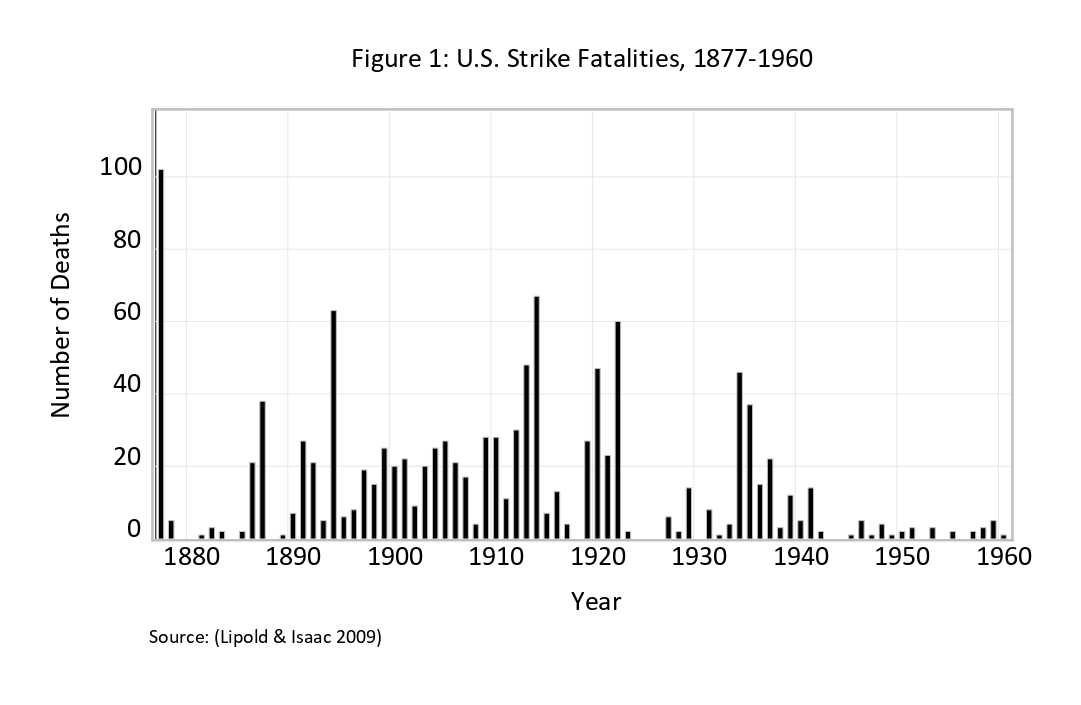
Growing strike violence. The earliest recorded U.S. strike—New York printers—occurred in 1775, and the record indicates that the first strike deaths did not take place until 75 years later (Lipold and Isaac, 2009, p. 168). The pattern of rare strike lethality changed within several decades. Between the 1870s and late 1940s, strikes became more deadly and “a whole new cultural epoch of contention” was opened in American labor-management relations (Lipold and Isaac, 2009, p. 168). That period of lethal contestation surrounding the strike can be seen in Figure 1. The years comprising the Gilded Age (c. 1870-1905) produced an annual average of 16.8 deaths in contrast to an annual average of .5 deaths in the 1960s. More than 1,000 individuals were killed in total because of “strike-related violence” in the U.S. from 1870 to 1970, and most of the victims were either strikers, labor organizers or sympathizers (64%), while the overwhelming majority of the killers were state agents (51.7%), hired company agents (11.3%), strikebreakers (7.7%), or vigilantes (10.4%) (Lipold and Isaac, 2009). So, the linguistic use of “strike-related violence” is much more accurate terminology than the commonly used “labor violence’ which implies that striking workers were the primary source of violence in such events (Lipold and Isaac, 2009, p. 168). As Lipold and Isaac point out (p. 168), “both before 1877 and after the 1940s, deaths resulting from labor strikes in America were, indeed, rare events.” And this lethal bloodshed on the picket lines mattered. Net of other conditions, higher annual levels of strike deaths muted subsequent labor mobilizations and political power (Lipold and Isaac, 2022). By killing strikers, employers and state authorities sent a powerful message, chilling the environment for dissenting worker collective action.
On balance, within this legal environment the dual tandem of scabs coupled with armed force was virtually unbeatable. When scabs were used by employers during a strike and they had armed support, labor typically lost.
Mass print media, labor problem, and strike discourse. In addition to the vectors of law and order shaping the public sphere, the expanding mass print media was a crucial force forging the discursive culture of Gilded Age public sphere and civil society. There was certainly diversity to this cultural field (Isaac, 2014), but one disproportionately tilted to bourgeois views of the labor problem, and within it, the strike.
The ‘labor problem’ was essentially discourse that posed, variously, either the problem of collective labor for society, or problems created by industrial capitalist society for the survival of laboring people. The meaning, therefore, was two-sided. The primary pivot was the labor movement, and especially what strikes and unionization meant for working people, employers, and young industrial America (Isaac, 2009). It was not simply that the social organization of work and collective contention surrounding it was changing, but also that a change in political culture, in discourse, about the meaning of these changes figured prominently in what the ‘labor problem’ and strikes meant and what the proper response to such actions might be.
The field of mass print media, comprised of a variety of genres, battled over precisely this meaning (Isaac, 2008, 2009, 2012). The mainstream news media was, of course, important, authoritative, and generally quite negative in its framing of strikes and strikers. For instance, Isaac, Coley, and co-author’s (2022) data indicate that in the mid-1880s, the New York Time’s published share (%) of negative stories relative to all strike stories was decidedly lopsided with a mean and median of 78.4% and 70.4%, respectively. Political leanings of specific newspapers’ varied, of course, but the mainstream press view of strikes was generally unfavorable. After all, the producers of these news stories and editorials were capitalist enterprises and any semblance of professional journalism norms was still off in the future (Isaac, Coley, et al., 2022).
Pictorial images presented in the press were even more biased. Photography was not introduced into regular newspaper reports until the late 1880s (Brown, 2002). But line-drawing art was used, and it was the main attraction of the pictorial weeklies, two of the most prominent of which were Harper’s Weekly and Frank Leslie’s Illustrated. Focusing on the more ready-to-view cover page art of these two weeklies for the January 1881 through December 1886 period readers would find that: Harper’s presented two cover pages dealing with strikes, both negative while Frank Leslie’s featured a total of 14 out of 15 images about strikes carrying a clear negative valance.
The messages delivered in such images were sharp and telling. Several themes clearly emerge, none flattering to strikers who are portrayed as (1) inflicting hardship on the innocent, especially families with children, (2) threatening, intimidating, and wrecking “good workers,” (3) anti-property and un-American; (4) engaging in evil doings as extremists, often immigrants, and (5) exemplifying worker violence and anarchy. Although clearly intended for the reading class, even the illiterate could read class from the line art featured in the popular illustrated weeklies (Isaac, 2008).
The production and circulation of negative strike discourse in the public sphere came in other print genres as well. Elites had ready access to arenas like authoritative journals such as the North American Review where the owner of the Pennsylvania Railroad, Thomas Scott, published his views of the 1877 general railroad strike. Allan Pinkerton, owner of the industrial detective agency bearing his name, published his contemporary account of the 1877 events in his Strikers, Communists, Tramps, and Detectives (1878) with the moral of the story pointing to how highly trained industrial detectives (the Pinkertons) could save America from the lurid doings of strikers, communists, and tramps (Isaac, 2008).
Realist fiction also played an important role in shaping the discursive field of the labor problem and strikes (Isaac, 2009, 2012). During the Gilded Age, the novel came to play an important part in providing a narrative base for issues threatening the social order from both elite and working-class perspectives. For purposes of characterizing collective actors, dramatizing emotion, ethics, aesthetics, providing imagery of threats, solutions to disorder, vividly characterized characters and collective identities, the realist novel was probably the best genre available at that historical moment (Isaac, 2008).
Between 1870 and 1919, more than 500 labor problem novels—stories that variously included some aspect of the labor problem especially unions and strikes—were produced in America (Isaac, 2009). There was a strong dialogical flavor to this literary formation—authors from one ideological stance on the labor problem would do literary battle with authors holding a different perspective, sometimes they were directly linked through character names and other tropes (Isaac, 2012). While variation in stances toward the labor problem certainly existed in this literary formation, they were not produced and circulated equally.
The question of how violence between labor and capital was portrayed is one significant consideration of this discursive inequality. Using Google’s Ngram search of digitized novels, we find that “labor violence” emerges on a growth trajectory around 1889-1900, while “employer violence” returns zero hits for the entire period. Novels contributed to the view that violence in class contention was due to workers but not employers. Analysis of labor problem novels over the Gilded Age (Isaac, 2009, 2012), find that strikes are disproportionately narrated with negative valence, but with the number of pro-striker stories increasing during the latter years of the Gilded Age. There is also evidence that discourse in this era had material consequences. For example, news accounts, editorials, and pictorial images that painted strikes in a negative light and denigrated strikers reduced the likelihood of strike success in New York City in the 1880s and into the early twentieth century (Isaac, Coley, et al., 2022b).
Through the public articulation in the authority of the law, the use of force which was often lethal, and massive negative discourse, the strike came to be defined in the first Gilded Age. That less than flattering construction has been handed down through official history, collective memory, and sedimented in legal institutions, especially in juridical interpretation and NLRB regulatory practice.
Strikes and the Civil Sphere in Three Regimes
During strikes, especially large strikes, the civil sphere was always an important part of the field of struggle. Strikes were never just about the two sides in the “private war” but spilled out into community and public sphere. Yet how this spilling out took place varied in historically significant ways across labor relations regimes. We illustrate this qualitative variability across three key periods--(a) the First Gilded Age/ Pre-New Deal Era; (b) the Heyday of the Accords in the 1950s; and (c) the Current Fractured Deal—with an eye toward variability in strike/civil sphere relations. Key features of this cross-period variability are summarized in Table 2.
Table 2. Strike Exemplars for Three Regimes of Labor-Management Conflict
Private War Public Sphere
Strike Event Labor Capital Labor Capital
Panel A: Pre-New Deal Open Warfare
Homestead, 1892 refusal to work under union-busting objective massive community support Pinkerton armed scabs
(local plant) partial lockout partial lockout armed battle with 300 call-up of 8,000 PNG
scabs used Pinkerton agents troops
Panel B: New Deal Institutionalization
Great Steel Strike of 1959 families stockpiled stock-piled steel inventory extensive & highly developed used press;
(national industry) resources, material community support; used letters to workers;
& social relations president urged president urged
used letters to workers
used union newspaper
support from wider labor
movement
Panel C: Neoliberal Fractured Deal
Detroit Newspaper Strike, union charges bad hired permanent replacement organized boycotts; published used private security 1995 faith bargaining workers alternative newspaper; forces; anti-striker
(city-wide) petitioned NLRB; litigation public campaign;
litigation
The First Long Gilded Age
Homestead Steel Mill Strike of 1892. Sitting on the banks of the Monongahela River, the Carnegie steel works at Homestead were massive and part of a dense factory system running along the river flats into Pittsburgh. Some of the neighboring mills had removed unions and/or never had them in the first place. On the other hand, the workers at the Homestead mills were represented by the Amalgamated Association, an organization that Andrew Carnegie and his general manager, Henry Clay Frick, were determined to eliminate.
Workers and townspeople, operating in astonishing solidarity, prepared for what they correctly anticipated as a showdown with Frick. They understood the culture of union-busting as it operated in their day and prepared for an invasion of strikebreakers as they organized themselves on a “military basis.” Serrin (1993, p. 73) writes:
Some four thousand men, both workers and townspeople, were divided into three divisions or watches, each on duty eight hours a day, with pickets posted at the roads leading into Homestead, at the two railroad stations, at the plant gates, and along both sides of the Monongahela River, to watch for attempts by the Corporation to bring in strikebreakers by boat or train … scouts were sent downriver to watch for invaders from the bridges at Pittsburgh.
Coupled with lookout power, a steam whistle code was used to warn the townspeople of approaching trouble. The community was in strong solidarity with the workers, and union preached nonviolence to retain community support and good public opinion.
The private war was launched by Frick as he locked out workers from certain portions of the mill. Workers responded by refusing to work in those parts of the mill still open. The major moves to the dénouement came in two rounds, both featuring armed force mobilized by the company. The first was the recruitment of 300 armed Pinkerton agents who were secretly moved down river in the dark of night. But given the workers’ intelligence system, the surprise was lost. When the Pinkertons attempted to land at Homestead, a pitched gun battle ensued. With much bloodshed, and several fatalities on both sides, thousands of workers and townspeople forced the Pinkerton agents to surrender. Round one went to the workers. However, when the sheriff reported to the governor that workers controlled the mills and he could not establish his authority, the governor sent Pennsylvania militia to Homestead—4,000 by land and 4,000 by river barge. The second wave of armed force, in effect, broke the strike.
In terms of local community, the solidarity and organization achieved by the workers and townspeople at Homestead in preparation for and enduring the clash was nothing short of amazing. Public opinion, at least that gauged by mainstream press across the country, was not so supportive. Newspapers carried editorials calling for the end of worker rule. In this case, the major sources of defeat came in the form of replacement workers backed by armed force under state command. The Amalgamated collapsed completely at Homestead and was severely weakened around Pittsburgh and elsewhere because of that defeat. Amalgamated continued its fight with Carnegie successor, U.S. Steel Corporation, but with little success. An effective steelworker’s union was still some four decades off in the future (Dulles and Dubofsky, 1993).
Frick exemplified an extreme but not uncommon anti-union sentiment among employers. A host of other well-known Gilded Age strikes were broken by the use of replacement workers and armed force (militia, industrial police forces, Army), including the Cleveland Rolling Mill strike (1882), switchmen in Buffalo (1892), metal miners in Coeur d’ Alene (1894), coal miners in Tennessee (1891-92), and the Pullman railroad strike (1894). During the years 1881-1886 alone, for 4,530 strikes, those facing replacement workers were far more likely to end in failure (68.3%) than if scabs were not deployed by a company (32.6%) (data drawn from U.S. Commissioner of Labor, 1888). Scabs were so destructive to the labor movement that Kimeldorf (2013) has theorized the roots of unionization are to be found in work conditions such as skill levels, timing of production delivery, and geographical isolation from population centers that would make the use of replacement workers more expensive.
During the Gilded Age, the discursive power of the mass print media was important and disproportionately favored property and capitalist interests. The mainstream press frequently attempted to distinguish between “good workers” and “bad workers” infected by “strike agitators” (Dulles and Dubofsky, 1993, p. 167; Isaac, 2008). Negative press in mainstream papers generally had a deleterious influence on public opinion that was ultimately very costly to the outcome of most strikes (Isaac, Coley, et al., 2022).
Postwar Institutionalization of the Strike
A reformist sentiment among portions of the employer class gradually developed beneath the froth of early labor-management conflict. In general, these corporate liberals supported collective bargaining with non-Leftist unions to achieve industrial peace. But it was not until the Supreme Court upheld the constitutionality of the Wagner Act, that the rights of some to form unions and collectively bargain were legally established; and the state interjected itself directly into labor-management negotiations through the NLRB.
The Wagner Act reflected a tentative legitimation of worker rights and concomitant, fusion of organized labor into a Democratic Party coalition of unlikely allies (Eidlin, 2017). Far from providing unionists carte blanche, however, various provisions within Wagner and subsequent legislation including Taft-Hartley and Landrum-Griffin demonstrated the limits to worker solidarity that employers, state, civil society, and many of the workers themselves were prepared to accept. Domestic workers and sharecroppers were excluded from protection; secondary boycotts and wildcat strikes were deemed illegal, and union leaders were forced to disavow Communism or risk decertification. As the coming decades were to demonstrate, this uniquely American form of legal-juridical foundation provided for both the rise of labor’s post-war heyday and subsequent decline (Cowie, 2016; Eidlin, 2017; Dixon, 2020).
The Great Steel Strike of 1959. Strikes remained numerous during this period of détente, and typically fluctuated with the business cycle and industry contract negotiations. But importantly, violence and bloodshed associated with strikes plummeted to rare instances (Lipold and Isaac 2009). The 1959 steel strike is indicative of the postwar pattern in a leading industry, and instructive regarding features of community relations and the public sphere.
In fact, the public sphere served as an important discursive venue in the years leading up to the strike, not in terms of the steel industry, per se, but rather in regards to troubling patterns of inflation, more generally (Smemo, Santi, and Winant, 2017). Senator Estes Kefauver, a New Deal Democrat and Chair of the Senate Subcommittee on Antitrust and Monopoly, placed blame squarely upon the oligopolistic, if not, monopolistic pricing power of corporate America, with specific emphasis on U.S. Steel (Smemo et al., 2017, pp. 52-3). The American Iron and Steel Institute countered with spots in more than 400 newspapers around the country seeking to place the blame for economic instability on union wages; and privately maneuvered to counter rising labor costs through increasing productivity, including their desire to eliminate Section 2-B of the industry standard collective bargaining agreement achieved in 1947 which disallowed alterations of established work practices unless required by the introduction of new technology (Smemo, et al., 2017).
The 1959 strike was one of the largest U.S. postwar strikes in terms of “man days idle” (length and mass) (Metzgar, 2000, p. 58). The strike was initially framed in terms of wages; but it was the work rules question that was most bitterly contested (Dulles and Dubofsky, 1993). Early on the White House asked for and received support from both sides for a contract extension. Eisenhower also invited leaders from both sides to the White House for talks. The strike began after contract negotiations broke-off in mid-July. By October, President Eisenhower invoked emergency provisions of the Taft-Hartley Act and ordered an injunction for the workers to return to the mills. Steel workers returned but planned to resume the strike over work rules when the injunction expired.
For the workers, preparation for the private war started at home, but extended outward into the community and was sustained by a dense set of institutional arrangements built by the union over the previous twenty years. In preparation for the private war, the steel companies stockpiled steel; workers built social relations and survival stockpiles, a culture of solidarity that glued together individual and collective resources. Before the companies even started talking aggressively, steel families began preparation for the strike “simply because strikes were a natural part of labor negotiations then” (Metzgar, 2000, p. 68).
The union did not pay strike benefits. To help deal with strike-induced hardships, the USWA produced a 32-page pamphlet, Beyond the Picket Line: How to Organize a Strike Assistance Program. The document instructed how counselors should meet with public and private “social agencies” (e.g., local welfare departments, Catholic Charities, Red Cross, Salvation Army) to determine current policies and procedures. These counselors would instruct troubled steelworkers and their families on how to get assistance when needed. If existing sources could not do the job, the union local might step in to make a mortgage or rent payment, or issue vouchers for food, medicine, fuel, or clothing at local businesses. If the local ran low on funds, it would make requests from the district office, which might in turn call upon the International (Metzgar, 2000).
The way the union articulated with civil society was built into a well-established union protocol. The strike moved into the community first through the striker’s family and home front and then outward through a series of established community support networks. This reflected a well-established system of social support, built up by the 1950s, extending from the families and union into the local communities. It was common for local businesspeople to cooperate with strikers, as part of a union-cultivated support network. Discipline and solidarity were crucial to steelworker strength, keys to winning the private war.
Of course, the strike reverberated into the public sphere. The sheer size, duration, and importance of the steel industry ensured that. The companies worked the press and sent open letters to workers’ homes extolling the virtues of their “final offer.” The USWA countered with their own discursive strategies that dissected company proposals as shallow and misleading. For example, the December issue of Steelabor carried one sentence printed in bold letters over a background of Steelworkers on picket lines: “If the companies get their way, 110,000 steelworkers could be knocked out of their jobs with a twenty percent speed-up.” With great fanfare and press attention, the wider labor movement provided cross-union support, symbolic and moral support as well as substantial financial contributions ($6 million) to the steelworkers’ strike relief fund (Metzgar, 2000).
When the companies finally capitulated, largely at the urging of the President, workers had forced a large cost. The USWA retained their work rules and won a substantial wage increase. It is remarkable at this point in history to see that replacement workers were apparently never even contemplated by the steel companies, even though a legal option, as they had been so frequently in pre-New Deal history. It was just not considered an acceptable part of normative institutional practice during a strike under the New Deal regime (Rosenfeld, 2014). In recent decades, as the New Deal regime has unraveled, the use of replacement workers has again become acceptable management practice for breaking strikes.
The Current Fractured Deal
President Eisenhower, a Republican, pushed industry to accept a union friendly settlement. Despite his preference to not intervene, he did so when the strike dragged on to the point that, in his view, the emergent steel shortage constituted a national emergency (Smemo, et al., 2017). His course contrasts sharply to that of Ronald Reagan, another Republican president, who in 1981 claimed to act in the national interest by summarily firing 11,000 striking air traffic controllers. Since at least the early 1980s, the institutional foundations for collective bargaining have weakened significantly to the point that it makes sense to speak of the deinstitutionalization of the New Deal regime. The attack on organized labor—coming through employer actions, political policy agendas, an antilabor judiciary, and a weakened NLRB—has had devastating consequences for unionization levels and strike activity. Consequently, strikes have declined in frequency and efficacy (Eidlin, 2017; Rhomberg, 2012; Rosenfeld, 2014), generating a self-reinforcing process.
This trend has prompted some scholars to submit that the strike has been transformed from what it was during the era of institutionalized collective bargaining to something quite different in the current era. Chris Rhomberg (2012, p.9) puts it this way:
the strike has been transformed from an economic tactic and protected legal right to a more high-risk confrontation in which the issues at stake are not just dollars and cents on the table but the continued existence of the collective bargaining relationship..
The Detroit newspaper strike: Rhomberg’s (2010, 2012) exemplar case, signaling a new era of labor-management relations, is the Detroit newspaper strike. Workers walked out in July 1995 over bad faith bargaining by the companies—i.e., Detroit Free Press, Detroit News (part of the Gannett chain), and Detroit Newspapers, Inc.—involving some 2,500 workers spread across some six different unions. Despite enormous economic costs inflicted on the companies—approximately $100 million in the first six months alone—and extensive litigation on both sides, the strike failed. Five years after the initial walkout, a federal Appeals Court overturned a favorable NLRB ruling, destroying labor’s hope for a settlement order.
This marathon struggle ultimately ending in a loss for workers in a historically labor-friendly location would make this case worthy of attention on these terms alone. But Rhomberg’s interest goes beyond these parameters to highlight the ways in which the Detroit newspaper strike signaled change in its spillover into wider civil society. Remarkable deviations from the previous era appear on both sides of the contest. On the one hand, we see the companies resorting to the tactic of hiring permanent replacement workers backed by militarized support, spending in excess of $40 million on security forces (Rhomberg, 2012). On the other hand, strikers moved beyond the bargaining table to engage support from actors in civil society—rallying support from the greater Detroit area, organizing circulation, and advertising boycotts, mobilizing civil disobedience and protest actions, publishing their own alternative strike newspaper, the Detroit Sunday Journal. The strikers drew widely and deeply upon the culture of labor solidarity historically sedimented in southeastern Michigan (Rhomberg, 2012). These features have been part of strike history, but in somewhat different ways, and do, in fact, signal significant transformation in how strikes are conducted today.
However, the form and degree of change requires close comparative historical attention. Our claim is that strikes in the current period are different in two major ways: First, employers are more likely to resort to the use of replacement workers coupled with armed force of one sort or another. This is a deviation from the previous era of institutionalized collective bargaining and is much more reminiscent of the pre-New Deal Gilded Age when labor-management conflict was thoroughly noninstitutionalized open battle. Second, the claim that strikes now are more likely to reverberate into the wider civil society requires qualification. Strikes did so as well during the pre-New Deal era and the New Deal era, but the character of strike/civil society relations was different in all three periods.
Table 3 summarizes these key elements across the three historical regimes of labor-capital relations. With respect to employers, the most common features deployed in their strike/lockout tactical repertoire include the use of replacement workers with armed support during the pre-New Deal era as well as the current period. Replacement workers were hardly ever used during the interim New Deal period.
The use of replacement workers, historically always a legally available option to U.S. employers, has been facilitated and encouraged in recent decades first by the performative power of the presidency. When Ronald Reagan fired 11,000 PATCO strikers and employed replacement workers in the air traffic control towers of America airports, he signaled to employers in both public and private sectors that scab labor was a viable strategy for managing labor disputes. Second, the courts use of criminal law—obvious in its bias against workers in the first Gilded Age—now whittles away covertly at the right to strike (White, 2008). Finally, the NLRB, the very institution created by the New Deal regime to administer and adjudicate the principles put in place by the Wagner Act has shifted to the political right and against labor in recent decisions by abdicating any attempt at balancing the long-term conflict between collective (Wagner) and individual rights (Taft-Hartley). In a series of recent decisions, the Board has signaled that, for the first time, individual freedom of choice—i.e., freedom to reject union representation—will trump the collective right in the statutory scheme (Liebman, 2008).
Table 3. Major Contexts for the Strike in Three Historical Eras
Political-Legal Sphere Public Sphere Civil Sphere
Long Gilded Age (c. 1870-1937)
De jure right to strike eviscerated by employer’s Dialogical diversity in the discursive culture, Unions increasingly important in
right to replace strikers + regular mobilization of but disproportionately tilted against strikers mobilizing strikes; some strong
armed force + use of violence (even lethal) against especially in the mainstream press community support of strikers; common
strikers backed by criminal law + court injunctions use of boycotts, sympathy strikes,
against strikers community flying squadrons, popular
protest; fight for unionization as a fight
for a way of community life; community
support often without union trying to
mobilize it
New Deal Institutional Regime (c. 1937-1981)
De facto right to use legally accepted forms of strike More favorable discourse about strikes; but Civil formations activated in non-protest
called by unions; labor’s most effective collective mainstream press still anti-striker but ways of support for strikers and their
tactics outlawed as part of the accords; replacement language not as vicious as in pre-New families; civil society relatively quiet
workers still legal but virtually never used Deal era in smaller, routine strikes and in non-
union areas; social movement field
drives worker militancy more than vice
versa
Deinstitutionalization of New Deal Regime (c. 1981-present)
De jure right to strike eviscerated by (a) employer Less strike discourse in mainstream press or Unions work to court community and
right to hire replacement workers + use of armed in popular literature; in part, this is due to the other supporters; greater use of social
support backed by criminal law + conservative declining frequency and efficacy of strikes movement tactics spilling over into
court rulings + increasingly conservative NLRB communities—metro-unionism,
rulings boycotts, consumer appeals, actions
somewhat reminiscent of pre-New Deal
_____________________________________________________________________________________________________________________
On the workers’ side, the early and current periods also share key elements that differentiate them from the New Deal Coalition era. In these two periods strikes often expanded out into and drew support from communities. But in the early period, local support tended to be more organic while in the current era unions work strategically to generate wider public support. During the interim New Deal period, strikes also spilled over into civil society. But when they did—usually during large strikes—they worked through community-based union cultivated support mechanisms to ease the pain of being out of work. This form of community nexus was generally more peaceful than counterparts in the previous and current periods.
In short, the transformation in strike contours in recent decades appears to be more similar in important respects to the early pre-New Deal era and dissimilar to the post-World War II institutionalization of labor-management conflict. The middle period was the “great exception” (Cowie, 2016) when it comes to the strike/civil society relationship.
Conclusions
A long-term historical view of U.S. strikes highlights the variable combinations of movement and institution that have developed over time. During the pre-New Deal era, strikes were initiated and endured as a social movement in a hostile environment doing battle with a highly resistant corporate field backed by state power and a militarized private industry specializing in strikebreaking. During the New Deal Coalition interim period, labor-management conflict continued in highly frequent episodes but under formal legal and informal rules (cf., Dixon, 2020). Recent decades mark a hybrid era, one in which elements of both previous periods are uneasily intermingled but tilting more and more toward the contours of the First Gilded Age. As a result, the strike itself shows features of both the social movement and institutionalized collective bargaining conflict. But the dominant features in the current period suggest that employers are playing to destroy unions and collective bargaining altogether and their key weapons are laws that allow replacement workers backed by militarized support. This has spawned a new support industry specializing in full-service strike replacement and security packages. Strikers, for their part, are relying much more heavily on wider social movement unionism combined with various forms of “coordinated strategy” (Bronfenbrenner and Juravich, 2001) that moves beyond the private bargaining table.
The public sphere and civil society have always played important roles in the history of the strike. The late nineteenth century Gilded Age set the initial conditions that shaped the strike against the wage relationship. Most significantly—a legal environment that largely criminalized strike activity, encouraged a militarized response to supporting replacement workers to break strikes with intimidation and lethal violence, along with media-produced discourse about strikers that was largely negative—all set the terms for what the strike meant and how it was treated.
Especially in large strikes, capital and labor have always resorted to strategies that engage the public sphere and civil society (Brecher, 1997; Lens, 1974). What has changed in recent decades is the qualitative character of the relationship between strikes and civil society actors in the community and society more broadly. The striker—community relations at Homestead in 1892 were very different from the national steel strike in 1959 or the Ravenswood and Detroit newspaper strikes of 1990 and 1995, respectively. Labor historian, David Montgomery (1980, p. 81) once wrote that “Collective work stoppages tear the tissue of ‘normal life’…” But exactly how widely and deeply they tear into ‘normal life’--the conditions under which the tear takes place and its meaning--can vary substantially.
Examining long-term regime comparative history of the strike gives us a clearer sense for how the strike has been attacked by employers and the state as well as how it has been supported within the community and civil sphere. It also gives us a clearer view of how conflicting repertoires of contention deployed by labor and capital have changed over the past century and a half. A key implication of this variability is that conventional transhistorical theories of strikes (both economic and political variants) are of limited use for understanding these changes.
Thinking seriously about the strike/civil society relationship can help identify where and how additional trenches and infrastructures can be built for support in anticipation of future strikes. Power has clearly shifted to employers in a degree not seen since before the 1930s. Greater flexibility to alter and move economic operations and a highly supportive political environment, including political parties, courts, the NLRB, and massive modern strikebreaking industry, have stacked the contemporary deck. Changing corporate behavior or the law governing strikes is not likely under current conditions. That leaves change in political culture in the civil sphere.
In recent decades, unions have worked hard to build support from and mobilize actors not directly involved in the private war of a strike. This involves the support of conscience constituencies across multiple communities as well as civil rights-interested social movement organizations. These are all important and helpful.
However, it is essential to also take a long-term perspective on change. Instead of concentrating solely on immediate needs for open conflict—i.e., working to gain support when labor is engaged in a direct strike action—the movement must think in terms of what Gramsci (1971) called the “war of position.” By war of position, he meant the slow, hidden, difficult and gradual tasks involved in civil society, not direct confrontation with the state. This entails building counterculture, changing political culture by building up social foundations of a new order, producing alternative culture through alternative institutions and alternative intellectual resources that socialize new generations and gradually change mass social values. Social movement schools (Isaac et al., 2020) of a labor movement/civil rights variety that can take many forms, would be an important alternative institution with alternative intellectual resources. Working the public sphere is important too. Here the use of creative, artistic talent to make the ideas of labor rights as civil rights come alive in an attractive fashion with art and music would be an important step (see Isaac, 2009, 2012).
The stakes are high, indeed, nothing short of the fiber of democracy hangs in the balance. Still writing within latter days of the post-WWII New Deal coalition era, Sidney Lens (1974, p. 399) noted: “You cannot whittle away at collective bargaining for any length of time without restricting the right to strike, and you cannot restrict the right to strike without restricting the right to dissent.”
Dissent, collective bargaining, and the strike are cornerstones of any real democracy. Defended against multiple external enemies throughout its history, American democracy has been under internal attack for the past several decades, and many have not noticed the threat within. It is our job to see that they do.
References
Adams, David. 1995. “Internal Military Intervention in the United States.” Journal of Peace Research 32 (2): 197-211.
Bartels, Larry M. 2008. Unequal Democracy: The Political Economy of the New Gilded Age. Russell Sage Foundation.
Brecher, Jeremy. 1997. Strike! Revised and updated edition. South End Press.
Bronfenbrenner, Kate and Tom Juravich. 2001. “The Evolution of Strategic and Coordinated Bargaining Campaigns in the 1990s.” Pp. 211-237 in Rekindling the Movement: Labor’s Quest for Relevance in the 21st Century, edited by Lowell Turner, Harry C. Katz, and Richard W. Hurd. Cornell University Press.
Brown, Joshua. 2002. Beyond the Lines: Pictorial Reporting, Everyday Life, and the crisis of Gilded Age America. University of California Press.
City of Cleveland. 1892, 1894, 1896. Annual Police Reports.
Cooper, Jerry M. 1980. The Army and Civil Disorder: Federal Military Intervention in Labor Disputes, 1877-1900. Greenwood Press.
Cooper, Jerry M. 1997. The Rise of the National Guard. University of Nebraska Press.
Cowie, Jefferson. 2016. The Great Exception: The New Deal & the Limits of American Politics. Princeton University Press.
Derthick, Martha. 1965. The National Guard in Politics. Harvard University Press.
Dixon, Marc. 2020. Heartland Blues: Labor Rights in the Industrial Midwest. Oxford University Press.
Dulles, Foster Rhea and Melvyn Dubofsky. 1993. Labor in America. 5th edition. Harlan Davidson, Inc.
Eidlin, Barry. 2017. Labor and the Class Idea in the United States and Canada. Cambridge University Press.
Feldacher, Bruce S. and Michael J. Hayes. 2014. The Labor Guide to Labor Law. 5th edition. Cornell University Press.
Gramsci, Antonio. 1971. [1929-1935]. Selections from the Prison Notebooks. International Publishers.
Gould, William B. 1993. Agenda for Reform: The Future of Employment Relationships and the Law. MIT Press.
Hattam, Victoria C. 1992. “Institutions and Political Change: Working-Class Formation in England and the United States, 1820-1896.” Politics and Society 20(2): 133-166.
Hinshaw, John. 2002. Steel and Steelworkers. SUNY Press.
Hovenkamp, Herbert. 1988. “Labor Conspiracies in American Law, 1880-1930.” Texas Law Review 66(5): 919-965.
Isaac, Larry. 2002. “To Counter ‘The Very Devil’ and More: The Making of Independent Capitalist Militia in the Gilded Age.” American Journal of Sociology 108 (2): 353-405.
Isaac, Larry. 2008. “Counter Frames and Allegories of Evil: Characterizations of Labor by Gilded Age Elites.” Work and Occupations 35 (November): 388-421.
Isaac, Larry. 2009. “Movements, Aesthetics, and Markets in Literary Change: Making the American Labor Problem Novel.” American Sociological Review 74 (6): 938-965.
Isaac, Larry. 2010. “Policing Capital: Armed Countermovement Coalitions against Labor in Late Nineteenth-Century Industrial Cities.” Pp. 22-49 in Strategic Alliances, edited by Nella Van Dyke and Holly J. McCammon. University of Minnesota Press.
Isaac, Larry. 2012. “Literary Activists and Battling Books: The Labor Problem Novel as Contentious Movement Medium.” Research in Social Movements, Conflicts and Change 33: 17-49.
Isaac, Larry W. 2014. “Cultures of Class in the Gilded Age Labor Problem Novel.” Chapter 6 (pp. 113-129) in Born Unequal: Class and the Making of American Literature, edited by Andrew Lawson. London: Routledge.
Isaac, Larry W. 2023. “Turning Points in U.S. Labor History, Political Culture, and the Current Upsurge in Labor Militancy.” Work and Occupations: Forthcoming.
Isaac, Larry W., Anna W. Jacobs, Jaime Kucinskas, and Allison R. McGrath. 2020. “Social Movement Schools: Sites for Consciousness Transformation, Training, and Prefigurative Social Development.” Social Movement Studies 19 (2): 160-182.
Isaac, Larry W., Rachel G. McKane, and Anna W. Jacobs. 2022. “Pitting the Working-Class Against Itself: Solidarity, Strikebreaking, and Strike Outcomes in the Early U.S. Labor Movement.” Social Science History 46 (2): 315-348.
Isaac, Larry, Jonathan Coley, Quan Mai, and Anna Jacobs. 2022. “Striking News: Discursive Power of the Press as Capitalist Resource in Gilded Age Strikes.” American Journal of Sociology 127 (5): 1602-1663.
Jacobs, Ronald N. 2000. Race, Media and the Crisis of Civil Society. Cambridge University Press.
Kimeldorf, Howard. 2013. “Worker Replacement Costs and Unionization: Origins of the U.S. Labor Movement.” American Sociological Review 78 (6): 1033-1062.
Laurie, Clayton D. and Ronald H. Cole. 1997. The Role of Federal Military Forces in Domestic Disorders, 1877-1945. Center of Military History.
Leach, Eugene E. 1993. “The Literature of Riot Duty: Managing Class Conflict in the Streets, 1877-1927.” Radical History Review 56: 23-50.
Lens, Sidney. 1974. The Labor Wars. Anchor Books.
Liebman, Wilma B. 2008. “Labor Law Inside Out.” Working USA 11 (1): 9-22.
Lipold, Paul F. and Larry W. Isaac. 2009. “Striking Deaths: Lethal Contestation and the ‘Exceptional’ Character of the American Labor Movement, 1870-1970.” International Review of Social History 54 (August): 167-205.
Lipold, Paul F. and Larry W. Isaac. 2022. “Repressing Worker Dissent: Lethal Violence Against Strikers in the Early American Labor Movement.” Labor History 63 (1): 1-23.
Mahon, John K. 1983. History of the Militia and the National Guard. Macmillan.
Metzgar, Jack. 2000. Striking Steel: Solidarity Remembered. Temple University Press.
Montgomery, David. 1980. “Strikes in Nineteenth-Century America.” Social Science History 4 (1): 81-104.
Montgomery, David. 1993. Citizen Worker. Cambridge University Press.
Norwood, Stephen H. 2002. Strike-breaking & Intimidation: Mercenaries and Masculinity in Twentieth-Century America. University of North Carolina Press.
Petro, Sylvester. 1978. “Injunctions and Labor Disputes: 1880-1932.” Wake Forest Law Review 14(3): 341-483.
Rhomberg, Christopher. 2010. “A Signal Juncture: The Detroit Newspaper Strike and Post-Accord Labor Relations in the United States.” American Journal of Sociology 115 (6): 1853-1894.
Rhomberg, Chris. 2012. The Broken Table: The Detroit Newspaper Strike and the State of American Labor. Russell Sage Foundation.
Richardson, Heather Cox. 2001. The Death of Reconstruction. Harvard University Press.
Riker, William H. 1957. The Role of the National Guard in American Democracy. Public Affairs Press.
Rosenfeld, Jake. 2014. What Do Unions No Longer Do. Harvard University Press.
Serrin, William. 1993. Homestead. Vintage Books.
Smemo, Kristoffer, Samir Sonti, and Gabriel Winant. 2017. “Conflict and Consensus: The Steel Strike of 1959 and the Anatomy of the New Deal Order.” Critical Historical Studies (Spring): 39-73.
Smith, Robert M. 1993. “Spies against Labor.” Labor’s Heritage, Summer: 65-77.
Tomlins, Christopher L. 1985. The State and the Unions: Labor Relations, Law, and the Organized Labor Movement in America, 1880-1960. Cambridge University Press.
U.S. Commissioner of Labor. 1888. Third Annual Report: Strikes and Lockouts. U.S. Government Printing Office.
Weiss, Robert. 1978. “The Emergence and Transformation of Private Detective Industrial Policing in the United States, 1850-1940.” Crime & Social Justice 9 (Spring/Summer): 35-48.
White, Ahmad A. 2008. “The Crime of Staging an Effective Strike and the Enduring Role of Criminal Law in Modern Labor Relations.” Working USA 11 (March): 23-44.
Wilentz, Sean. 1989. “The Rise of the American Working Class, 1776-1877.” Pp. 83-151 in Perspectives on American Labor History, edited by J. Carroll Moody and Alice Kessler-Harris. Northern Illinois University Press.