Introduction
Of all the forms of protest in contemporary societies, labor strikes are the best-known manifestation and, together with marches or demonstrations, the most recurrent within the repertoires of modern contention (Tarrow, 2011, p. 111). However, labor strikes are not a homogeneous type of protest, but rather a family of contentious repertoires (Hyman, 1989). Various subtypes of strikes differ in their content, goals, scale, and geographical scope (Franzosi, 1995).
Among the distinctions between types of strikes, the most traditional and relevant is the one between economic and political strikes (Luxemburg, 1906; Crook, 1934; Silverman, 1966). Economic strikes target public or private sector employers, usually to demand changes or improvements in working conditions or employment. On the other hand, political strikes aim to draw attention to a particular political issue or protest against a government policy, and as such, they are typically the result of conflicts between unions and governments over public issues.
Although state agencies have historically attempted to reduce labor strikes to their purely economic manifestation, the political dimension has regained centrality in liberal democracies. The global trend toward weakened trade union movements and the decline of economic or company strikes (Gall, 2013) has been accompanied by a significant growth of political strikes (Lindvall, 2013; Gallas & Nowak, 2016; Gall, 2013).
The resurgence of the political dimension of strikes has led to recent developments in the quantitative literature, particularly on the European continent (Hamann et al., 2013; Hamann et al., 2016; Lindvall, 2013; Nam, 2007). Studies conducted in Europe explain this resurgence of political strikes as a reaction to the global trend towards labor flexibility and the resulting pressure on unions to adopt confrontational positions towards governments, often calling for general political strikes to oppose free market-oriented reforms (Baylus, 2014; Sánchez, 2018). This confrontational reaction from trade unionism is not exclusive to Europe, as noted by Richard Hyman (2015), who recognizes that the trade union movement has reacted globally in the last decades of the 20th century to curtail labor policies promoted by different governments.
The study of political strikes becomes particularly relevant in Latin America, considering trade unions have faced exceptional challenges the last decades due to an unprecedented number of labor and economic projects associated with the Washington Consensus of 1989 (Williamson, 1990). These free-market policy packages have threatened the citizenship rights of many Latin American citizens and driven new social movements in the region (Almeida, 2007). Labor movements in Latin America have responded to these challenges by staging general political strikes of varying intensity and consequence in recent decades (Madrid, 2003; Silva, 2009; Petras, 2018).
Despite the absence of systematic quantitative studies on the characteristics and consequences of political strikes in Latin America - which is primarily explained by the fact that the record kept by countries in this region has focused exclusively on economic strikes at the company level -, non-quantitative literature on the labor movement has consistently mentioned political strikes. Scholars have recognized that political strikes have been essential for understanding the different impacts of trade unionism on political systems in the region (Madrid, 2003; Petras, 2018; Collier & Mahoney, 1997; Murillo, 2005; Cook, 2010). When political strikes become general, they pose the greatest threat a government can face from organized civil society (Carbonai, 2019; Murillo, 2001). Governments have made substantial concessions in response to general political strikes, leading to changes in labor legislation and the cancellation of privatization processes (Cook, 2010; Trujillo & Spronk, 2018).
To have a better understanding of this crucial political phenomenon for the Latin American region, in this article I propose a conceptual definition and a methodology for measuring political strikes at three hierarchical levels: the company, the economic sector, and the general level. For this study, I coded an original database that covers a period of thirty years, from 1990 to 2019, a period that captures the pressures unions faced with market reforms, from the Washington Consensus to the year before the 2020 pandemic. This database represents a significant step towards developing systematic quantitative studies on the characteristics and consequences of political strikes in the region.
In the empirical section, I present results that support two descriptive hypotheses. Firstly, political strikes have become increasingly prominent in Latin America, as they have in Europe. Secondly, there is significant variation across countries in the extent to which trade unionism can engage in political strikes, both in terms of their frequency and generalization. I propose a tentative argument to account for the differences in the intensity and scope of political strikes across Latin America, which relates to the level of autonomy and cohesion of the trade union movement in each country. Overall, this article presents the initial findings of an original database on the characteristics of political strikes in Latin America, puts forth descriptive hypotheses about overall trends, and discusses the results while providing a tentative explanation for the observed variation.
Political strikes and economic strikes
[What] gives Unions and the strikes arising from them their real importance is this, that they are the first attempt of the workers to abolish competition. They imply the recognition of the fact that the supremacy of the bourgeoisie is based wholly upon the competition of the workers among themselves; i.e., upon their want of cohesion. And precisely because the Unions direct themselves against the vital nerve of the present social order, however one-sidedly, in however narrow a way, are they so dangerous to this social order. (Engels, 1845).
Labor strikes constitute a modern contentious repertoire whose origin and expansion can be traced back to the consolidation of nation-states and the development of modern industry in Europe, mainly during the 19th century (Tarrow, 2011). As national states began to concentrate the political power and labor grew around modern enterprises (Tilly, 1992), coordinated work stoppages became increasingly meaningful, expanding throughout Europe on different geographical scales. In the early days of the labor movement, strikes often addressed both economic and political demands simultaneously since economic power was often held by those in political power. However, the development of a capitalist bourgeoisie and the autonomization of the political bureaucracies in modern states led to the differentiation of two broad subtypes of strikes: economic, which target employers to protest against issues related to workers' material interests, such as wages or working conditions; and political, which target political authorities to draw attention to a particular political issue or protest against a government policy.
The early writings of Marx and Engels on trade unionism and workers' organization make reference to both economic and political strikes. For example, they mention the 1844 miners' strike in northern England as an economic strike and the 1842 strike that spread throughout Britain as a general political strike (Engels, 1845; Marx, 1847). However, their writings do not provide a conceptual treatment of political strikes and their differentiation from economic strikes beyond discussing the potential of trade union action in generic terms. It was not until the beginning of the twentieth century that the distinction between the two types of strikes became evident, as governments in different parts of the world began to institutionalize labor strikes, but exclusively economic ones, in an attempt to make political strikes invisible in official records (Haimson & Tilly, 2002, p. 40).
Historically, political strikes have been obscured by the official statistics of modern states. Therefore, defining and measuring these phenomena requires a certain level of originality, as state agencies do not recognize or capture this type of strike. The conceptual debate surrounding the differentiated nature of political strikes and economic strikes began in the early 20th century, particularly with the contributions of Lenin and Rosa Luxemburg. The work of Wilfred Crook (1934) furthered this theoretical discussion, which remains open in the field of political science. In this section, I will provide definitions of both subtypes of strikes to facilitate a measurement proposal. To begin with, we must identify the concept of strikes in generic terms.
A review of the literature reveals that economic and political strikes are commonly regarded by scholars as falling within the same category of contemporary contentious repertoire. It is thus necessary to identify what defines a strike in generic terms. To proceed, I will adhere to Collier and Levitsky's (2009) suggestion of first identifying the root concept, i.e., the primary constituent elements of a phenomenon, before identifying its subtypes. Building upon the works of various authors such as Hyman (1989) and Edwards (1993), this discussion will commence by defining the root concept of a generic labor strike as a temporary stoppage of work, coordinated by a group of workers in order to express a grievance or enforce a demand to a counterpart. Both political and economic strikes involve articulating a set of demands to a counterpart; the key distinguishing factor lies in the identity of that counterpart. In other words, the specific attribute that sets them apart is the target towards which they mobilize in order to resolve their collective demands. While economic strikes target public or private sector employers, usually to demand changes or improvements in working conditions or employment, political strikes are aimed at government or political authorities to prompt modifications or reorientations in their public policy pertaining to the political, social, or industrial sphere.
This distinction does not imply that there is not a sometimes blurred threshold between political and economic strikes. In fact, political strikes often have a reciprocal relationship with economic strikes. For example, many economic strikes come from redefinitions formerly institutionalized from political strikes due to the effects of a change in legislation. However, they will still be economic strikes insofar as they avoid raising demands to the sphere of State policy and remain within the relationship of subordination established with their direct or indirect employer.
Similarly, the political nature of a strike does not necessarily exclude economic goals. Unions may have industrial demands that can only be satisfied by the government's alteration of an aspect of the political system. For example, workers may obstruct a legislative activity or mobilize against some aspect of a public policy to ensure their employment conditions are maintained. By calling strikes for these reasons, unions do not exert economic pressure on an employer but political pressure on the government (Silverman, 1966) but with goals of economic improvement.
A common confusion between types of strikes occurs in the case of public employees. While the above definitions suggest that any strike in the public sector is necessarily political because the target is the State, there are instances where public employees mobilize against the State as an employer and not as a political authority, which is an economic strike. For example, a strike from public employees demanding a better salary agreement should be seen as an economic strike. However, suppose the government needs to modify or reorient its public policy in the social or industrial sphere to improve working conditions. In that case, the conflict moves into the political sphere, which makes it a political strike.
Finally, following the above definitions, we have the issue of the geographic scale on which economic and political strikes can operate. Political strikes can operate at three levels according to their scope.
-
Local political strikes
-
Sectoral political strikes
-
General political strikes
The first level is local political strikes (LPS), which target political power from one or a group of companies (usually large), such as workers of an innovative company facing labor regulation issues from the state.
The second level is sectoral political strikes (SPS), which occur when a group of companies in the same economic sector are affected by government policies, such as the mining sector pressing for new regulations. For example, when the mining sector presses for new legislation to better regulate different aspects that affect the sector. These mobilizations are usually driven by a macro-union organization of an economic sector, such as a federation.
Finally, the third level is general political strikes (GPS), which occur when a political strike emerges from the stoppage of multiple economic branches on an inter-regional or national scale. These forms of conflict are of great national significance, involving public control and government authorities, and are usually led by one or several macro-union organizations, such as federations or confederations of workers.
Although the term "general strikes" is sometimes used interchangeably with general political strikes (GPS), the two concepts are not always the same. While in recent times, general strikes have often been organized to challenge governments, historically, they have also been used to target multiple economic sectors. For instance, Wilfrid Crook (1934) clearly distinguishes between general economic and general political strikes, highlighting this difference. Nevertheless, more recently, trade unions in Latin America and Europe usually coordinate general strikes as a means of protesting against government policies, which aligns them with the GPS framework (Gall, 2013).
Political versus revolutionary strikes
To fully grasp the distinctions between political and other types of strikes, we must move to the difference between political and revolutionary strikes. In her influential book Mass Strike, Party and Trade Unions, Rosa Luxemburg (1906) highlights the gradual nature of strikes, where economic strikes typically begin at the company level but can evolve into a revolutionary expression of political dissent. Similarly, Lenin (1975, pp. 83-90) notes that political strikes allow the working class to emerge as the advanced class of all people, serving as a vanguard on matters that concern the political landscape of the entire country. The idea of a leap from the economy to the field of politics could well be understood as a higher level of politicization.
But despite the apparent superiority of political strikes in terms of class struggle, the seminal works of Lenin, Rosa Luxemburg, and George Sorel stress the importance of distinguishing between a political strike and a revolutionary process.
While Lenin supported strikes as a workers' manifestation, he consistently cautioned that they alone were insufficient for a revolucion. In fact, in more than a few writings, one can see a certain distrust of the Russian leader towards trade unionism and strikes because of the possible deceptive effect of false triumphs they would generate in the working class (Hammond, 1949).
For Rosa Luxemburg (1906), the mass strike (which involved a revolutionary moment) was beyond a political strike, as it involved both economic and political demands in a broad movement of workers that transcended the traditional limits of unions and political parties. The mass strike was spontaneous, creative, and self-organized, allowing workers to move toward a more structural transformation of society.
In his influential book, Reflections on Violence (1908), George Sorel argues that a general political strike is not the same as an insurrection since it does not place the lives of politicians in danger. A political strike aims for a change or modification in politics and does not intend to replace the existing order with a new one. Therefore, a political strike is a reformist, not a revolutionary, event.
In his notable academic work, Wilfrid Crook (1934) classifies general strikes into three types: economic, political, and revolutionary. In this typology, the General Economic Strike (GES) seeks to improve workers' conditions in various sectors, while the General Political Strike (GPS) targets the state without intending to transform society but to secure concessions from the authorities. Finally, the General Revolutionary Strike (GRS) aims to introduce chaos in society and the State to overthrow the existing order.
Considering the insights of the authors mentioned above, it becomes clear that political strikes share more similarities with economic strikes than with revolutionary strikes. Both political and economic strikes entail making demands to a particular entity, whether it be the State or an employer. Mass or revolutionary strikes, on the other hand, go beyond making demands and instead aim to challenge the fundamental existence of the counterpart. Principio del formularioFinal del formulario
Although it is accurate not to consider political strikes as revolutionary processes, it can be misleading to assume that neither political nor economic strikes involve politicization processes. If we view politicization as a force that aims to transform the institutional rules of politics (Mouffe, 2011) - which can range from the politics of an individual company to the politics of an entire country- it is clear that both political and economic strikes can undergo significant politicization processes. In fact, the call for better employment conditions can be a crucial step towards empowering workers and reclaiming control over the labor process.
In the first volume of Capital and the Manuscripts of 61-63, Marx focuses on the passage from formal to the real subsumption of capital over labor, which is a tendency of capitalism towards the increasing subordination of the worker by the productive process. Thus, strike activity may seek to reclaim control of these processes from the capital. The economist John Roemer (1982) identifies three central processes in capitalist production that range from least to most complex and hierarchical: i) control over the resources produced, ii) control over the physical instruments of production, and iii) control over the organization of labor. An economic labor strike can easily challenge these three levels of control. Recent empirical research provides evidence regarding the existence of these levels of dispute and, thus, of a politicization process in economic strikes within firms (Medel, Velásquez & Pérez, 2022; Campusano, Gaudichaud, Osorio, Seguel & Urrutia, 2017).
These politicization processes also occur in political strikes. These political strikes can be defensive, resisting government reforms or political initiatives (Gallas & Nowak, 2016; Crook, 1934), or they can be offensive, such as seeking new legislation or increased spending in a specific area. When political strikes go on the offensive, they aim to redefine the policy field, bringing into discussion elements that are not part of the current authorities' collective decision-making plane. Some studies point out that the political strikes in Argentina and Mexico in the 1990s were primarily defensive (Madrid, 2003). However, we can also observe general political strikes of an offensive nature, such as the general strikes of 2019 in Chile, which articulated demands for elaborating a new constitution (Osorio & Velásquez, 2022).
Political strikes in Latin America
In regions such as Europe, GPS have become more common, especially since the crisis of neoliberalism in 2007 (Gall, 2013; Lindvall, 2013; Johnston et al., 2022). This growth has generated prolific literature re-emphasizing these strike demonstrations targeting governments (e.g., Gallas, A. and Nowak, 2016; Hamann et al., 2016; Lindvall, 2013; Johnston et al., 2022). In contrast, there has been less quantitative research on Latin America. However, several case studies and comparative analyses demonstrate the relevance of these manifestations, particularly given the region's economic transition from an import substitution model to free market economies over the last few decades (Edwards & Lustig, 2001; Lora, 2012). During this transition, whose starting point could be established with the Washington Consensus of 1989, free-market-oriented economic and labor reform projects encountered resistance from various social actors in Latin American countries (Silva, 2009; Roberts, 2014).
In this scenario, political strikes, especially GPS, have become increasingly important in Latin America in response to government reforms or policies that threaten workers' rights. However, political strikes in the region are not solely defensive; many are undertaken to propose alternative policies or to remove politicians from office. The labor movement has not been alone in this enterprise. Democratic transitions in the region have highlighted the weight of social actors once invisible to the State (Rossi, 2015; Silva & Rossi, 2018). The labor movement is just one of many social actors involved in the waves of protests that have swept the region, especially in the last decades. This is especially relevant given that GPSs have proven to be catalyzing in the outcomes of many social crises in the region, often resulting in the fall of presidents. (Lucena, 2000; Willis et al., 1999; Weyland, 2004). All this in a period also marked by a changing political context, with the emergence of a new cycle of progressive governments (Silva & Rossi, 2018) and new right-wing governments pursuing greater economic deregulation (Luna & Kaltwasser, 2014). In this article, I posit as an initial descriptive hypothesis that, as in Europe, there has been an increase in the prevalence of political strikes in Latin America over the past few decades.
While most Latin American countries implemented trade, financial, fiscal, and labor reforms during the 1990s and 2000s, there were significant variations in the depth of these reforms, particularly in labor reforms (Madrid, 2003; Murillo, 2005). These differences reflect, among other things, trade unions' capacity to carry out successful political strikes, particularly GPSs. In some cases, GPSs have slowed down and shaped labor reform projects (Cook, 2010; Murillo, 2005).
A telling example of the impact of GPSs on labor reforms in Latin America can be seen in the case of Argentina's 1998 labor flexibilization reforms. Under pressure from the International Monetary Fund (IMF), President Carlos Menen pushed labor flexibilization reforms, which were met with three GPSs that year organized by the General Confederation of Labor (CGT). According to scholar María Lorena Cook (2010), the GPSs put enough pressure on the government to resist and modify the reforms, particularly on aspects that threatened the unions' interests.
However, not all countries have carried out successful political strikes with the same intensity as Argentina, in some cases not even having the capacity to mount GPSs. For example, Chile's Central Unitaria de Trabajadores (CUT) refrained from calling GPSs during the first years of the transition to democracy. It was only during the Lagos government in 2003 that the CUT called the first GPS since the transition (Cook, 2010, p. 135), which had no significant political impact.
Brazil provides a more recent example of the different capacities of unions to carry out successful strikes. In 2017, the country experienced its first GPS in decades. The reason behind this was the approval in July 2017 of the country's most extensive labor reform since the enactment of the emerging Labor Consolidation Law of 1943. This reform sparked heated debates and led unions to launch two GPSs in April and June of the same year (Carbonai, 2019). Although the GPSs did not manage to alter the legislation, they proven the growing importance of political strikes in the region.Principio del formulario Final del formulario
Mexico stands at the opposite end of the spectrum, where labor unions are largely controlled by political authorities, leaving them with minimal ability to economically slow down the country through a general strike (Alzaga, 2018; Modonesi et al., 2010). Nevertheless, unions have still been able to organize significant sectoral strikes, as demonstrated by the Sindicato Mexicano de Electricistas (SME) in 2009, following the government's decision to dissolve the company Luz y Fuerza del Centro (LyFC) (Modonesi et al., 2010).
In summary, the ability of the trade union movement in each country to carry out political strikes of sectoral and general scope has varied significantly. While in some countries, political strikes are few and of narrow scope (they tend to be local), in others, political strikes are a tool of permanent use and with greater convening capacity (they tend to be general rather than local).
Therefore, my second descriptive hypothesis based on quantitative data is that political strike activity in Latin America will have an important variation between countries in terms of frequency and generality during the period studied (1990-2019).
In the following section, I present a methodology for measuring political strikes in Latin America and the initial findings from an original database. Additionally, I will present a preliminary argument for the reasons behind trade unionism's varying ability to engage in general strikes.
Data and method
This section presents the methodology to construct an original database on political strikes in Latin America. To my knowledge, this is unpublished data for the region. Although there are studies that have used the Cross-National Time-Series (CNTS) database that considers the frequency of strikes of more than a thousand workers directed against the state for several countries in the world (e.g., Zárate-Tenorio 2014; Kim et al., 2020), this database does not exclude public sector strikes that mobilize against the government in its capacity as employer, so it is not a database on political strikes according to the definition adopted in this article. Moreover, the CNTS database only considers frequency and does not study strikes' internal and external characteristics.
This original database considers 795 political strikes for 12 Latin American countries. For the writing of this article, the project had the data with the entire series (1990-2019) only for South American countries, Mexico, and Costa Rica. For constructing the database, I resorted to the protest event analysis methodology (Koopmans & Rucht, 2002). This methodology derives from quantitative content analysis (Krippendorff, 2009) and employs systematic coding of contentious events taking place in the space and period of interest. The primary source for the coding of events resides in newspaper data (although other media also exist) about collective protests in public places.
The source of news data for this project was the LatinNews information portal, which has been providing comprehensive political, economic, and current affairs news for Latin America on a weekly basis since 1967. LatinNews is a widely recognized source for academic purposes (e.g., Cook, 2010), as its news reports offer extensive coverage and detail. The nature of the events coded in this study, particularly general political strikes, are unusual events of national interest, so it is unlikely that these data would not be covered by the portal's weekly reports. While it is not possible to guarantee that all political strikes in the region are captured in the database, it does include all strikes reported by LatinNews, a highly respected source for studying contentious political events in Latin America.
The first phase consisted of creating a codebook for coding the variables. This codebook includes rules and examples to identify a political strike and code the variables of interest associated with the dynamics of the event. The codebook was finalized after the first inductive phase, as is highly recommended for constructing codebooks in content analysis (Schreier, 2012; Krippendorff, 2009).
The second phase associated with the construction of the database involved a comprehensive review of the weekly reports. Using the codebook, three coders reviewed all the material of the LatinNews portal for every Latin American country included in this study from 1990 to 2019. This first sweep sought to identify the unit of analysis, that is, to determine the total number of political strikes in Latin America during the three decades under study. Ultimately, the coders collected 3,311 press releases related to political strikes from the LatinNews portal, and 978 political strikes were identified. The majority of these strikes (56%) occurred in Argentina, Peru, Brazil, Bolivia, Uruguay, and Chile.
Finally, after identifying and distributing the strikes among the coders, they began to code a series of variables associated with the mobilization dynamics specific to the strike events—for example, adhesion of other actors, massiveness, tactical deployment, and government concessions. At the event level, they coded 96 variables, which we hope to complement with other contextual variables. Although data for 12 countries are ready for now, the project is contemplating completing the database for Central America and the Caribbean.
Finally, the coding procedure considered a resampling of 20% of the total events already coded by one coder and assigned to another coder to evaluate the consistency in code assignment. The inter-coder reliability criterion was 0.89, which is very good reliability according to conventional criteria for this type of methodology (Krippendorff, 2009).
In the next section, I will present descriptive statistics that illustrate longitudinal trends and the various types of political strikes by country. These statistics will provide evidence for the two hypotheses presented earlier in the article. This stage is crucial to establish a diagnosis of the quantity, evolution, and characteristics of general strikes in Latin America from 1990 to 2019.Principio del formulario
Final del formulario
Results
Some trends in Latin America
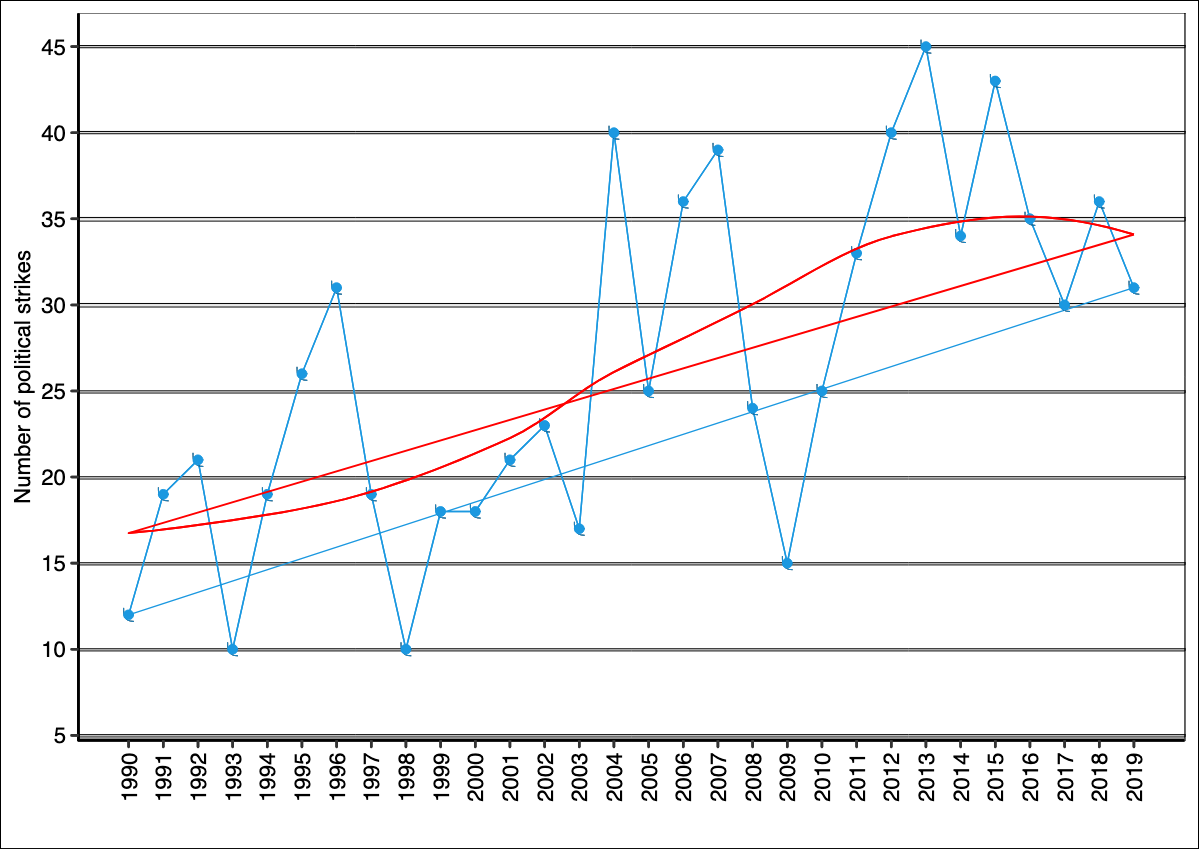
Research has demonstrated that strike trends tend to be cyclical, experiencing periods of ups and downs depending on the context in which they occur. Political strikes follow this pattern, as evidenced by Figure 1, which shows fluctuations in the number of political strikes over the three decades of this study. These cycles may be influenced by internal factors within trade unionism or politics in each country, as well as general macroeconomic reasons and political pressures that affect the region as a whole. While not the focus of this analysis, we note two significant downturns in the late 1990s and late 2000s, which coincided with the Asian crisis of the '90s and the subprime crises of the late 2000s, both of which affected the region. Scholars have noted that worsening economic conditions tend to lead to a reduction in strike activity (Rees, 1952; Ashenfelter & Johnson, 1969), which is also true for political strikes according to the data.
Figure 1. General trend of political strikes in Latin America (1990-2019)
Source: Prepared by the author based on data from the Fondecyt project. N° 11220613
In addition to short cycles, long cycles are also worth considering. Over the last three decades, there has been a trend towards an increase in political strikes in the region. This trend is represented by the smoothed curve in Figure 1 (LOESS), which shows that we are in the midst of a long cycle of growth in political strikes. This trend supports the first descriptive hypothesis regarding the growth of political strikes in Latin America in recent decades, in line with what has occurred in other regions. Multiple reasons may have contributed to the increase in political strikes, but the consolidation of democracies in the region is undoubtedly one of them. Democracies substantially drop the intensity of repression of collective protest and guarantee rights for the collective demonstration of their citizens. In addition, liberal democracies have experienced a general growth of non-electoral political participation, especially in protest activities. Therefore, we can associate the growth in political strikes with one more characteristic of the third wave of democratization (Huntington, 1991). The third wave of democratization arrived in Latin America in the late 1980s and early 1990s, making it plausible to associate the consolidation of these democracies with the sustained increase in political strikes, if we understand the latter as a form of non-electoral political participation.
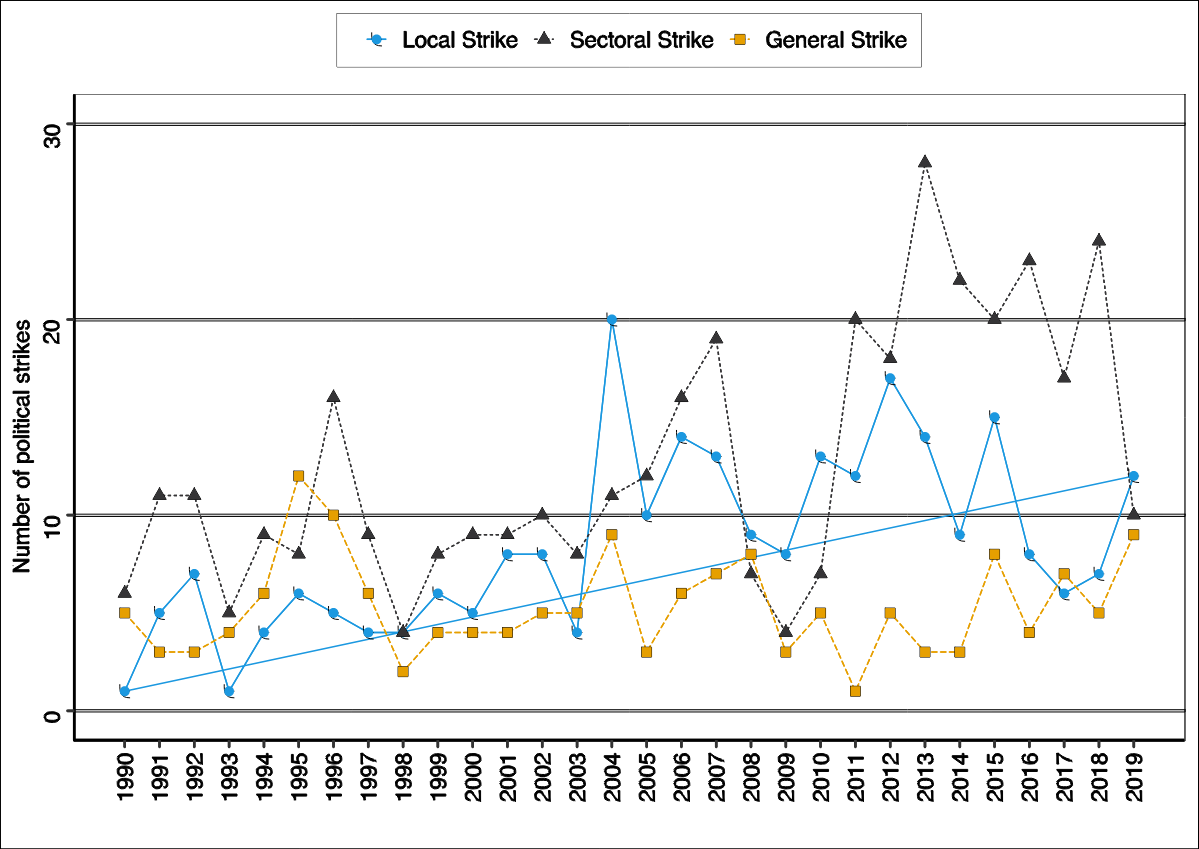
Figure 2. Political strike by type (1990-2019)
Source: Prepared by the author based on data from the Fondecyt project. N° 11220613
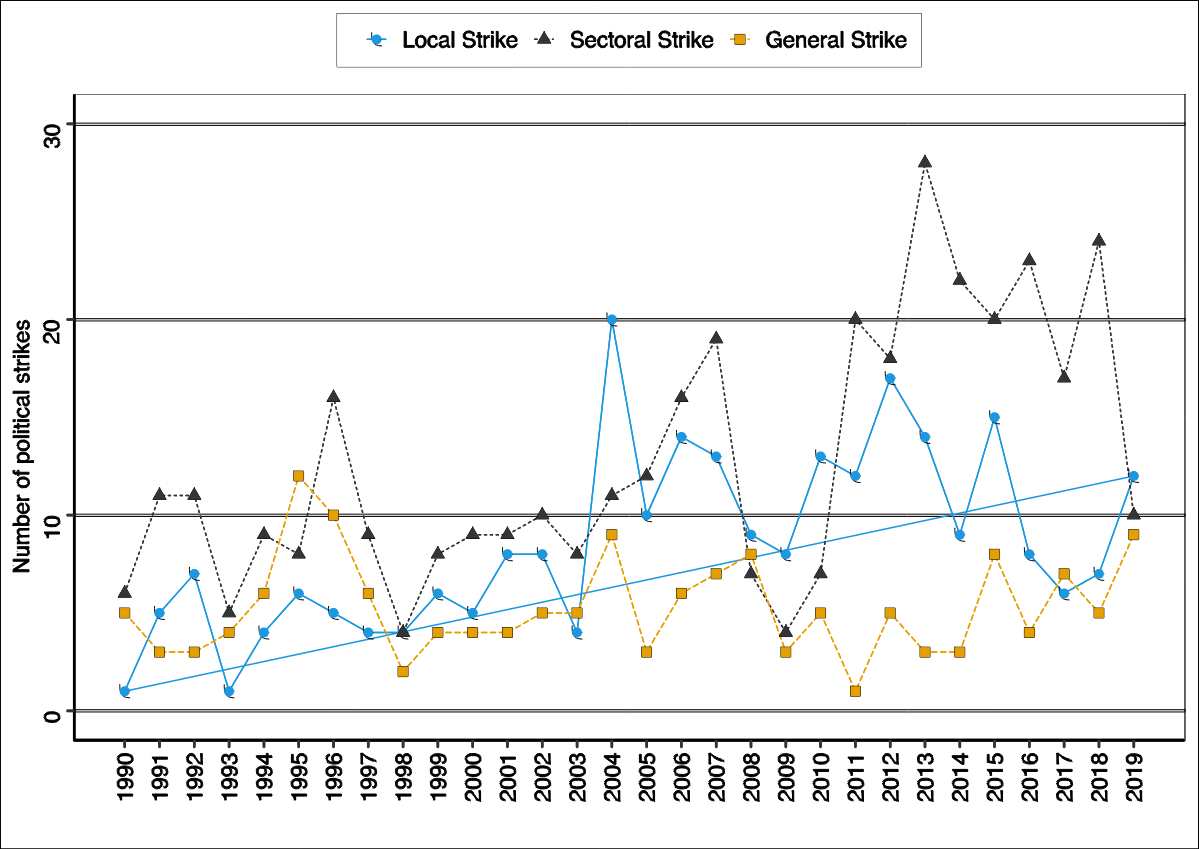
Another factor to consider is the type of political strike that has increased during the period. We must examine trends for the different types of political strikes: local, sectoral, and general. Figure 2 shows that the frequency of general political strikes (GPSs) has remained relatively stable over the last three decades, occurring between 5 and 10 times a year. Meanwhile, the frequency of local political strikes (LPSs) has slightly increased in the period. However, the main driver of the upward trend in political strikes was the growth in sectoral political strikes (SPSs). This trend could be attributed to the diminishing use of political strikes as a centralized tool in the hands of large trade union federations or to the fragmentation of trade unionism, where unions are beginning to form around economic sectors to advance demands specific to their conditions. Further analysis of this phenomenon requires examining variations in the frequency and type of predominant political strikes across different countries.
Figure 3 displays the variations in the number and types of political strikes among different countries. Undoubtedly population size plays a significant role in these statistics, so to obtain more accurate comparisons, we may need to examine the number of strikes per million inhabitants. However, the raw data presents interesting observations. For instance, large countries like Mexico have fewer political strikes than smaller countries like Uruguay. Furthermore, Peru, a country with low union membership and fragmented trade unionism, experienced the most political strikes during the studied period.
On the other hand, significant variations in the type of political strike prevail in each country. For instance, Bolivia and Uruguay have a significant presence of general political strikes (42% and 32%, respectively) and a low incidence of local strikes. In contrast, Mexico experiences a high incidence of local strikes (64.9%), with a complete absence of general political strikes during the study period, at least according to the sources of information mentioned earlier. Countries like Chile fall somewhere in between, with SPSs being the dominant type (67.7%), and GPSs occurring infrequently (7.7%). In the following section, I will propose a tentative explanation for these differences.
Figure 2. Political strike by type (1990-2019)
Source: Prepared by the author based on data from the Fondecyt project. N° 11220613
Country comparison
In the previous section, we observed that the frequency and types of political strikes vary significantly across Latin American countries. In this section, I propose an approach to understanding this variation: the intensity and scope of political strikes in each country are influenced by the cohesion and autonomy of their labor movements. Cohesion refers to the level of unity within labor movements, which can range from a single national confederation to multiple ones. Autonomy, on the other hand, refers to the extent to which trade unionism is free from capture by political groups or the state, in other words, the level of corporatism in the country.
A lack of cohesion within a labor movement can pose a significant challenge to organizing successful general strikes. When the supra-union organizations are highly fragmented, it becomes challenging to mobilize the rank and file and coordinate their actions effectively, ultimately weakening the overall capacity to carry out general strikes. Moreover, the fragmentation of trade unionism into several confederations may make it more difficult to establish a common set of demands among organizations, leading to a lack of general lines of convergence in their objectives.
On the other hand, autonomy is important, because when the state or political groups capture trade unionism, labor movements are less likely to mobilize against political authorities. Likewise, given the general discrediting of party politics, when the main trade union federations are extensions of political parties or institutional politics, it becomes challenging for trade unionism to form alliances with other social actors. Such alliances could be essential to broaden the base of support for labor movements and build the necessary momentum for sustained mobilization (Silva, 2009; Roberts, 2014).
Many people mobilized in general strikes often differ from the classic idea of protected workers (direct and stable labor contracts). On the contrary, the protagonists have often been precarious workers (Gallas & Nowak, 2016), the new victims of neoliberalism (Winn, 2004). Moreover, similar to what has happened with other traditional organizations, there has been a questioning of the legitimacy of existing unions and their claim to represent workers. As a result, the traditional sections of the labor movement, which were historically very close to institutional politics, are being pressed to gain autonomy to broaden their support from the rank and file. Therefore, a large part of the success of the GPSs depends on the ability of the leading trade union federations to call other social actors to mobilize, especially those who are playing a leading role in these latest waves of protests against the neoliberal model (Silva & Rossi, 2018).
Thus, to achieve a broad call for a general political strike, the labor movement needs union cohesion and relative autonomy from parties and institutional politics. To give some flesh to this argument, I will briefly take three cases of union movements with different capacities to call for general political strikes. First, the labor movement in Uruguay, which, according to my database, has the greatest capacity to carry out political strikes among Latin American countries (if we consider the number of inhabitants). Uruguay also shows the highest percentage of general strikes and the lowest percentage of local strikes.
At the other extreme, we have the labor movement of Mexico, a case with very few political strikes, considering the size of its population, where most of them are local and with a total absence of general strikes. Finally, between these two extremes, we have the labor movement of Chile, a case with several political strikes, but where the majority are sectorial, and only a few are general.
The Uruguayan trade union movement stands out for its centralized structure under a single large trade union Confederation known as the PIT-CNT. This is a notable feature of Uruguayan trade unionism that is frequently highlighted in the literature on Latin American labor movements (Supervielle, Rivero, & Cosse, 2018). The cohesion and centrality of the Uruguayan union movement enable the PIT-CNT to effectively call for mobilization and carry out general strikes. It is important to note that while the union movement in Uruguay is highly centralized, there are still differences and autonomy among the unions. In fact, empirical studies suggest that each member federation of the PIT-CNT has a high level of relative autonomy, as expressed in the fact that many sectoral conflicts do not escalate into a generalized confrontation (Alegre, 2006). Additionally, Uruguay's centralized collective bargaining system is crucial for successful sectoral negotiations and articulating the different local unions.Principio del formulario
Final del formulario
Furthermore, the PIT-CNT has always had unions and federations with diverse political views and tensions, which have allowed for significant autonomy and diversity within the organization. This diversity means that no single political party or bloc can easily capture trade unionism. The PIT-CNT's very constitution defines it as a convention of union federations that grants considerable freedom to individual organizations to adopt their own union strategies, even if they differ from the rest of the unions (Alegre, 2006). The PIT-CNT is also the de facto organization that represents the interests of workers in public bodies such as the Tripartite Superior Council (Silverman, 2012). Thus, the Uruguayan trade union movement has a high degree of mobilization capacity with significant centrality in these mobilizations, and very few political strikes occur at the local level.
Mexico is at the other extreme in terms of strike activity. The Mexican case is interesting since it shows that labor movement cohesion is insufficient for calling general strikes. Since its origins, the leaders of the main union confederations have been part of the Institutional Revolutionary Party (PRI) and constitute the historical pillars of corporatist unionism, although with different levels of importance over the years. In 1966 the main union leaders founded the Congreso del Trabajo (CT) (Rubio, 2017). The foundation of the CT (Bensusán & Middlebrook, 2013) was an effort to coordinate all the confederations and generate common positions of the leaders around formulating public policies of the State. Although the Labor Congress is a kind of confederation, similar to the PIT-CNT, there is an enormous difference as it functions as the main articulating body of trade union corporatism in Mexico.
Contrary to what happened in various Latin American countries, the role played by the bulk of the labor movement in in Mexico during the 90s was to resist democratization and maintain their quotas of institutional power based on a social pact that was disintegrating (Bensusán & Middlebrook, 2012). As a result, between 1990 and 2020, the Mexican labor movement and the CT defended conservative positions and contention against any reform mounted against its prerogatives. In that sense, the labor movement in Mexico has played a conservative rather than a reformist role in the face of recent democratization processes.
While the federations have developed some important sectoral strikes, such as those carried out by mining, electrical, and maquiladora workers' organizations, the vast majority of Mexican trade unionism remains consolidated around the PRI and the CT. This lack of autonomy from institutional politics has resulted in very little capacity for unified challenge against state authorities. The few small union organizations that are autonomous from the PRI and aligned with the leftist Party of the Democratic Revolution (PRD) have limited influence. The co-optation of trade unionism by the corporatist apparatus of the State and its governments has left it with little ability to mobilize a general strike. In fact, no evidence exists of any such labor protest during the period from 1990 to 2019.
Finally, between these two extremes, we have the case of Chile, a country with low autonomy from the central Confederation and medium to low union cohesion. Although the Central Unitaria de Trabajadores (CUT) is currently the indisputably predominant union Confederation (the other two Confederations are very marginal), its capacity to mobilize the rank and file is limited due to low representation in the private sector (Medel, 2020). Since the transition to democracy in 1990, the CUT has sought to represent the labor movement as an extension of political parties, particularly the center-left coalition that governed the country for the first two decades post-transition (Osorio, 2017).
However, during the 1990s, the Confederation's failure to question the economic model inherited from the dictatorship and reluctance to push for new legislation on private-sector unionism eroded its legitimacy. As a result, the Confederation lost union membership in the private sector and faced accusations of political party capture, increasingly becoming focused on public sector unionism. This crisis culminated in a re-foundational process in 2003 with leadership changes and the inclusion of more left-wing parties in the Confederation's directory. Scholars view this moment as the CUT's political turn, aimed at gaining autonomy from the governing center-left coalition and reclaiming its influence in private sector trade unionism. In that same year, the CUT called for the first general strike since the return to democracy to demand the fulfillment of unmet promises related to a new labor code. However, the strike turnout was low, and the Confederation failed to achieve its objective of erasing the institutional legacy of the dictatorship.
Despite the CUT's efforts, its cohesion never fully recovered, particularly in private sector trade unionism, which remains distant and critical to this day. During these three decades, the CUT's calls for general strikes never achieved massiveness (except the one in 2019, which happened during the social revolts) and were incapable of exerting pressure, due to internal wear and tear. The Confederation has been stigmatized as co-opted by center-left parties in the eyes of private sector rank-and-file workers. As a result, despite being the predominant Confederation in the country, the CUT's calls for general strikes have been largely ineffective and have failed to generate significant political impact due to a lack of costly paralyzations.
Conclusions
This article aimed to provide an understanding of political strikes, their recent trends in Latin America, and their relevance for a better understanding of politics in the region. In the first section, the article delves into the conceptual challenges of defining political strikes. To this end, the conceptual section presents some classic and recent theoretical discussions surrounding the concept and provides a comprehensive definition: political strikes are coordinated labor stoppages directed against government authorities to draw attention to a particular political issue or protest against a government policy.
The conceptual part highlighted that political strikes are not necessarily opposed to economic strikes; they can often enter a reciprocal relationship. There is also an important distinction between the political strike and a revolutionary process, since the former does not seek to destroy the political institutionality but to modify its course. Also, conceptually, a political strike can have at least three levels of generality, ranging from local to sectoral and general. All these conceptual distinctions are the basis for this article's proposed measurement of the political strike phenomenon.
The empirical section of this article utilizes an original database to describe general trends in political strikes in Latin America for three decades (1990-2019) and to test two descriptive hypotheses. The first hypothesis is that political strikes have been growing in the region, which is consistent with global trends (Gallas & Nowak, 2016; Gall, 2013). The second hypothesis is that there is significant variation in the capacity of trade unions across Latin America to generate political strikes and call for general political strikes. The evidence supports both hypotheses and suggests a political interpretation of the results. First, political strikes have gone hand in hand with the democratization processes of the subcontinent- and the consequent expansion of non-electoral political participation-, becoming a frequently used method of working citizens to pressure political authorities. Second, the differences in capacity of labor movement to carry out GPSs can be attributed to the ability of leading trade union federations to mobilize their own members and other social actors, particularly precarious workers and other social movement actors who may be skeptical of institutional politics. Therefore, to achieve a broad call for a GPS, labor movements require cohesion and relative autonomy from parties and institutional politics.
All these results highlight that studying political strikes is relevant for many reasons. One notable reason is that it sheds light on the trade unionism's physiognomy and the dominant political forces in each country. Political strikes offer insights into the intricate relationship between politics, the state, and trade unionism. Moreover, political strikes are a fundamental tool of any labor movement that seeks to impact a government's public policies.
Future studies on Latin American politics should focus on the importance of GPSs, given the region's unique labor movements and unstable government. Also, several studies have revealed the diversity in the outcomes of general political strikes. While in some cases GPSs were effective in impeding privatization processes, preventing reforms, and even removing presidents (Cook, 2010; Trujillo & Spronk, 2018), in other instances, the scope and magnitude of the strikes were insufficient to halt reforms or persuade the government to respond to the strikers' demands (Carbonai, 2019; Murillo, 2005). General political strikes will inevitably continue to play a leading role in the future of labor reforms and public policy. Still, there are many questions to be answered about the causes and consequences of these political events in Latin America. Hopefully, this study will be an impulse to continue exploring the role of political strikes in promoting social change and challenging governments worldwide.
References
Alegre, P. (2006). La transformación del sindicalismo uruguayo en los ´90: Crisis y re-estructura en un contexto de cambio. Documentos de Trabajo del IPES, Monitor Social n°10. Universidad Católica del Uruguay.
Almeida, P. D. (2007). Defensive mobilization: Popular movements against economic adjustment policies in Latin America. Latin American Perspectives, 34(3), 123-139.
Alzaga, O. (2018). Huelgas, sindicatos y luchas sociales en la historia de México [Strikes, workers and social struggles in Mexican history]. Alegatos, 99, 411-434.
Ashenfelter, O., & Johnson, G. E. (1969). Bargaining theory, trade unions, and industrial strike activity. The American Economic Review, 59(1), 35-49.
Baylus, A. (2014). Derecho a huelga, crisis económica y gestión sindical del conflicto [The right to strike, the economic crisis and trade union conflict management]. Revista de derecho social, (66), 13-33.
Bensusán, G., & Middlebrook, K. (2012). El sindicalismo y la democratización en México. Foro Internacional, 52(4), 796-835.
Bensusán, G., & Middlebrook, K. J. (2013). Sindicatos y política en México: cambios, continuidades y contradicciones. FLACSO Mexico/UAM-X/CLACSO.
Campusano, Karim, Gaudichaud, Franck, Osorio, Sebastián, Seguel, Pablo y Urrutia, Miguel. 2017. Conflictividad laboral y politización en los procesos de trabajo: Una propuesta teórica para el análisis de la trayectoria reciente del movimiento sindical chileno. Nuevo Mundo Mundos Nuevos
Carbonai, D. (2019). Labor Reform in Brazil, Politics, and Sindicatos: Notes on the General Strikes of 2017. Journal of Politics in Latin America, 11(2), 231-245.
Collier, R. B., & Mahoney, J. (1997). Adding collective actors to collective outcomes: Labor and recent democratization in South America and Southern Europe. Comparative Politics, 29(3), 285-303.
Collier, D., & Levitsky, S. (2009). Conceptual hierarchies in comparative research. In D. Collier & J. Gerring (Eds.), Concepts and Method in Social Science: The Tradition of Giovanni Sartori. Routledge.
Cook, M. L. (2010). Politics of labor reform in Latin America: Between flexibility and rights. Penn State Press.
Crook, W. H. (1934). The revolutionary logic of the General Strike. American Political Science Review, 28(4), 655-663.
Dussel, E (1988) Hacia un Marx desconocido. Un comentario de losmanuscritos del 61-63 [Towards an unknown Marx. A commentary on the manuscripts of 61-63]. Siglo XXI.
Edwards, S., & Lustig, N. C. (Eds.). (2001). Labor markets in Latin America: Combining social protection with market flexibility. Brookings Institution Press.
Edwards, P. K. (1992). Industrial conflict: themes and issues in recent research. British Journal of Industrial Relations, 30(3), 361-404.
Elbert R. (2017), Union organizing after the collapse of neoliberalism in Argentina: The place of community in the revitalization of the labor movement (2005-2011), Critical Sociology, 43(1), 129-144.
Engels, F. (1845). The condition of the working class in England. Marx-Engels Internet Archive. https://www.marxists.org/archive/marx/works/1845/condition-working-class/
Kim, D., Kim, M. S., & Villegas, C. (2020). Organized Labor Strikes and Social Spending in Latin America: The Synchronizing Effect of Mass Protest. Latin American Politics and Society, 62(2), 99-109.
Marx, K. (1847). The poverty of philosophy. Marx-Engels Internet Archive https://www.marxists.org/archive/marx/works/1847/poverty-philosophy/
Franzosi, R. (1995). The puzzle of strikes: class and state strategies in postwar Italy. Cambridge University Press.
Gall, G. (2013). New forms of labour conflict: a transnational overview. In M. Atzeni, (Ed.) Workers and labour in a globalised capitalism. Palgrave Macmillan.
Gallas, A. y Nowak, J. (2016). Mass strikes in the global crisis. Workers of the World. 1(8), 6-15.
Haimson, L. H., & Tilly, C. (Eds.). (2002). Strikes, wars, and revolutions in an international perspective: Strike waves in the late nineteenth and early twentieth centuries. Cambridge University Press.
Hamann, K., Johnston, A., & Kelly, J. (2013). Unions against governments: Explaining general strikes in Western Europe, 1980–2006. Comparative Political Studies, 46(9), 1030-1057.
Hamann, K., Johnston, A., & Kelly, J. (2016). The electoral effects of general strikes in Western Europe. Comparative Politics, 49(1), 63-82.
Hammond, T. T. (1949). Lenin on Russian Trade Unions Under Captialism, 1894-1904. American Slavic and East European Review, 8(4), 275-288.
Huntington, S. P. (1991). Democracy's third wave. Journal of democracy, 2(2), 12-34.
Johnston, A., Hamann, K., & Field, B. N. (2022). A Strike against the Left: General Strikes and Public Opinion of Incumbent Governments in Spain. Political Studies, 70(3), 837-864.
Hellinger, D. C. (2014). Comparative politics of Latin America: Democracy at last? Routledge.
Hyman, R. (1989). Strikes (4th ed.). Macmillan.
Hyman, R. (2015). Tres hipótesis sobre el futuro de las relaciones laborales en Europa [Three hypotheses about the future of industrial relations in Europe], Revista Internacional del Trabajo, 134(1). 5-15.
Koopmans, R., & Rucht, D. (2002). Protest event analysis. Methods of Social Movement Research, 16, 231-59.
Krippendorff, K. (2009). The content analysis reader. Sage.
Lapides, K. (Ed.) (1987). Marx, Engels on the trade unions. International Publishers.
Lenin V. (1975) Lenin Collected Works, Volume 18. Progress Publishers.
Lindvall, J. (2013). Union density and political strikes. World Politics, 65(3), 539-569.
Lora, E., (2012): Structural reform in Latin America: What has been reformed and how it can be quantified, IDB Working Paper Series, No. IDBWP-346, Inter-American Development Bank (IDB), Washington, DC
Lucena, H. (2000). El cambio en las relaciones industriales en América Latina [The change in industrial relations in Latin America]. In Tratado Latinoamericano de Sociología del Trabajo. México: Fondo de Cultura Económica, 422-450
Luna, J. P., & Kaltwasser, C. R. (Eds.). (2014). The resilience of the Latin American right. JHU Press.
Luxemburg, R. (1906). The mass strike, the political parties and the trade unions. In H. Scott (Ed.), The Essential Rosa Luxemburg, 111-181.
Madrid, R. L. (2003). Labouring against neoliberalism: Unions and patterns of reform in Latin America. Journal of Latin American Studies. 35(1), 53-88.
Medel, R. M., Velásquez, D., & Pérez, D. (2023). Politization in labor conflict: analyzing the demands of post-authoritarian chilean strikes. Critical Sociology, 49(1), 77-96.
Medel, R. M. (2021). La CUT y los clivajes sindicales en Chile. Entre la pretensión transformadora y la estrategia defensiva. CUHSO (Temuco), 31(1), 176-199.
Mouffe, C. (2011). On the political. Routledge.
Modonesi, M., Oliver, L., López de la Vega, Mariana, & Munguía, F. (2010). La lucha del sindicato mexicano de electricistas [The struggle of the Mexican electrical workers trade union]. OSAL, 27, 117-125.
Murillo, M. V. (2005). Sindicalismo, coaliciones partidarias y reformas de mercado en América Latina [Unionism, Political Coalitions and Market Reforms in Latin America]. Siglo XXI de España Editores.
Nam, T. (2007). Rough days in democracies: Comparing protests in democracies. European Journal of Political Research, 46(1), 97-120.
Osorio, S., & Velásquez, D. (2022). El poder sindical en el “Estallido social” chileno: La huelga general de noviembre de 2019. RES. Revista Española de Sociología, 31(1), 12.
Osorio, S. (2017). De la estrategia concertacionista al sindicalismo de contencion. Un balance de la CUT en la postdictadura, 1990-2016. Trabajadoras y trabajadores. Procesos y acción sindical bajo el neoliberalismo chileno, 1979-2017, 127-153.
Petras, J. (2018). The Left Strikes Back: Class Conflict in Latin America in the Age of Neoliberalism. Routledge.
Poulantzas, N (1973). On social classes. New Left Review, (78), 27.
Rees, A. (1952). Industrial conflict and business fluctuations. Journal of Political Economy, 60(5), 371-382.
Roemer, J. E. (1982). New directions in the Marxian theory of exploitation and class. Politics & Society, 11(3), 253-287.
Roberts, K. M. (2014). Changing Course in Latin America. Cambridge University Press.
Rossi, F. M. (2015). The second wave of incorporation in Latin America: A conceptualization of the quest for inclusion applied to Argentina. Latin American Politics and Society, 57(1), 1-28.
Rubio Campos, J. (2017). Sindicalización y precariedad laboral en México. Región y sociedad, 29(68), 37-75.
Sánchez, M. (2018). Trade unionism and social pacts in Spain comparative perspective. European Journal of Industrial Relations,24(1), 23-38.
Schreier, M. (2012). Qualitative content analysis in practice. Sage Publications.
Silva, E. (2009). Challenging Neoliberalism in Latin America. Cambridge University Press.
Silva, E., & Rossi, F. (Eds.). (2018). Reshaping the political arena in Latin America: From resisting neoliberalism to the second incorporation. University of Pittsburgh Press.
Silverman, S. (1966). Australian political strikes. Labour History, (11), 28-39.
Silverman, J. (2012). Labor Relations in Uruguay under the Frente Amplio Government, 2005–2009: From Neoliberalism to Neocorporativism? VII Global Labour University Conference, University of Witwatersrand, South Africa.
Sorel, G. (1999). Reflections on violence. Cambridge University Press. (Original work published in 1908)
Supervielle, M., Rivero, L., & Cosse, L. (2018). El XIII Congreso del PIT-CNT “Wladimir Turiansky”. Una observación etnográfica. Novos Rumos Sociológicos, 6(9), 114. https://doi.org/10.15210/norus.v6i9.14248
Tarrow, S. G. (2011). Power in movement: Social movements and contentious politics. Cambridge University Press.
Tilly, C. (1992). Coercion, capital, and European states, AD 990-1992. Blackwell.
Trujillo, J. & Spronk, S. (2018). Socialism without workers? Trade unions and the new left in Bolivia and Ecuador. In E. Silva, F. M. Rossi, Reshaping the Political Arena in Latin America: From Resisting Neoliberalism to the Second Incorporation. University of Pittsburgh Press.
Weyland, K. (2004). Neoliberalism and democracy in Latin America: A mixed record. Latin American politics and society, 46(1), 135-157.