Introduction
This article sets out a strategy for transnational collective action that is aimed directly at platform capitalists: Workers unite, organise and mobilise to pressure platforms to change their practices. Firstly, at city-level, when taking on platform companies, the new actors in the struggle, the platform workers, despite being separated in time and space, start by grouping in collectives thanks to social networks and meeting places. Then they join forces together with or on the fringes of trade unions so that they can organise in different ways depending on the country. Since the first strike of couriers in London in August 2016, they have organised direct actions and new strikes with specific demands all over Europe. The collectives also create convergences between precarious and platform sectors, paving the way for a potential “cybertariat.
If they began city by city, collectives act on multiple levels: their mobilisations take place at the local, but also at the national and European levels, as was seen by the organising of the European General Assembly (EGA) of couriers in October 2018, the case study developed here. For now, the gains from this strategy may seem limited, we will see how a new collective ‘glocal’ actor (one who thinks globally and acts locally) is being created in the process. It starts with the grassroots level - in each city where the platforms are located - and rises to transnational level.
Although we highlight the experience of the EGA, that provides what we consider to be the “operating manual” of the transnational struggle, it is important to better identify the main remaining challenge: the coordination of demands at different levels (local, national and, especially, transnational) to extract a common substratum of demands. Our focus on the EGA and its actors as a potential “autonomous” subject on the European stage, asks the questions:
-
How can we imagine a system that can be recast outside of the prevailing framework of institutionalised social dialogue?
-
Is it possible to found an “autonomous” trade union actor at this level?
Before getting to the heart of the matter, let us set out the methodology and the limits of our article with regard to the countries and sectors covered. We will be building on the field work that started with the setting up of the EGA in October 2018. As a privileged participant observer in this Assembly, I was able to gather the complete transcripts (in the French and English versions) of the two days of meeting in Brussels. These are particularly rich research sources; most of the quotations in this text are taken are from these sources and supplemented by numerous interviews with the spokespersons of the main countries.
In terms of geographical coverage, the study deals with the major regions of the EU with the exception of the Eastern European countries and on the basis of a special focus on the countries involved in setting up the European Courier Assembly. Concerning the sector, we will specifically address the hot meal-delivery sector. This on-demand labour platform sector is certainly only the tip of the iceberg of platform capitalism, which includes many other types of platforms. However, they do raise questions about platform workers’ ability to resist labouring without any social rights. Given their visibility, delivery workers are, in fact, part of the urban landscape and are spearheading a new wave of resistance which we will analyse in detail.
1. Forming workers collectives: A move towards new collective identities
Between 2016 and 2017, Europe formed the backdrop for a whole series of different actions, triggered by angry platform workers, mainly working in the bicycle-meal delivery sector. The starting point for creating these new collectives was generally the unilateral and drastic slashing of wages. Workers then resorted to the virtual world of social media to join forces but they also met in person and saw the need to mobilise. Their workers’ collectives therefore emerged as the trailblazers of a new “cybertariat”. This is why it is so important to understand the new forms of collective identification and representation at work in these various collectives and the role played by the trade unions.
1.1 Forming a community despite being separated in time and space
The hot meal-delivery sector analysed here faces three particular difficulties with regard to organising. The first obstacle is that the labour communities are fragmented. Only the platforms have access to contact details of all workers in a given area. The second obstacle is that these communities are also separated by time. For couriers, this is linked to both the discontinuity of working periods and working time: on average, a courier is active for two or three months and works 10 hours a week: this means that both the high levels of rotation (or turnover) of workers in the sector as well as the intermittent times worked pose genuine difficulties in their ability to organise. Finally, the third obstacle is the diversity of their sociological profiles. In the beginning, in 2017, this meant that common or overlapping demands had to be sought out between workers with very different interests. Indeed, in this period, it was necessary to establish a common link between, for example, the student putting in a few hours a week to save up for a holiday, the self-employed artist working to top up his greatly fluctuating income, and the under-qualified worker who is often a member of a racialised group and who has no other choice than to work 40-to-50 hours a week because there are no other jobs on offer due to qualifications or legal status issues?
Furthermore, it has been observed that over time, this diversity itself has changed. The couriers of the first platforms which appeared in 2013 (Take Eat Easy and Deliveroo) did not come from the same social strata as those who are now delivering: they have gone from “middle class” couriers, mainly bike lovers, who were bored of their jobs and wanted to change their lives by doing some sport, to a relatively young population facing discrimination on the labour market”.
Two French surveys, within the space of two years, point to a sharp increase in the presence of “professional” delivery workers, i.e. with no other activity (either paid or in the form of training), to the detriment of those engaging in this activity either to top up their income or finance their studies. “Professional” delivery workers increased from 25 to 48% in the space of two years among the population surveyed. The significant increase in full time workers depending on this activity as their sole means of livelihood makes it necessary to think of these activities as an occupation and of these workers as requiring collective organisation in the face of the platforms.
1.2 Aggregate: Thanks to social networks, leaflets and meeting places
Despite all of the sector’s difficulties, self-organised collectives have been created wherever platforms are active. The stages in their creation are similar from one country to another. They generally start with Facebook, WhatsApp or Telegram groups which are used to organise the first groupings. The “virtual community” this creates is important in meeting the challenge of fragmentation. Then, the organised workers produce leaflets whenever some form of action is planned, and they distribute them to all couriers whilst sending the information around on social networks. These socialising stages, both virtual and real, raise collective awareness of a shared identity.
To respond to the fragmentation referenced above, one other task “that unites all couriers is that of creating and sharing common areas for breaks and resting periods. These assembly areas can either be workshops where bicycles are repaired for free, which promotes self-organisation, or specific meeting points in the city. More recently, since 2020, 'courier houses' have appeared in various European cities, including Paris, Vienna and Brussels, often opened by unions linked to the collectives. They are friendly spaces that provide the necessary services for couriers: battery charging stations, toilets, drinks, bike repairs, and sometimes advice on the regularisation of undocumented people.
Social networks, flyers and above all meeting places are therefore three key elements in the first phase of forming a collective that aims to bring together as many workers as possible in each city, with a view to working on joint future actions. Then, three factors make it possible to consolidate and grow these groups so as to move from aggregation to organisation.
Firstly, the change of geographical scale. Local collectives need to meet each other, or even scale up to national level. For example, in Italy, “in April 2018, we held a coordination assembly at national level bringing together the couriers from all local platforms, and we launched a joint 1st May initiative in Bologna, Milan and Turin” (Riders Union, Bologna, Italy). At the time of the EGA of couriers, in October 2018, among the 24 collectives listed, 10 have already achieved national representation, and 14 at city level. At transnational level, it is still in the making at European level, as we see with the EGA.
Secondly, it is obviously the taking part in collectives’ mobilisations that allows them to consolidate by progressively forming a collective identity. This is not a given, it is built through the ways of discussing work, expressing common demands and especially through mobilising. Experience has shown that solidarity and the feeling of belonging to a community are greatly activated in times of action.
Thirdly, reinforcing the actions are the links created with certain trade union organisations, even if these links may vary depending on the country and organisational trends in question.
1.3 Organising: Together with or on the fringes of trade unions
In many respects, mobilising platform workers constitutes a renewal of trade unionism which may raise questions about the links of and trends in “traditional” trade unions. One trend seeks to extend the heritage of anarcho-trade unionism or revolutionary trade unionism. It favours self-organisation and stands in opposition to a second trend in trade unionism known as “reformist” or “institutional”. The self-organisation trend aims at both bringing about improvements in workers’ daily lives and building strike movements with the objective of radically transforming society. For those backing this approach, the emancipation of salaried workers can only come from workers’ direct action, in other words, their capacity to shape the course of history by their struggles, outside of providential recourse to political parties or the State. In 2018, in the European Assembly, the English, Spanish, Italian and one of the two German couriers’ collectives represented this trend. They either had links to or were created by trade unions that are sensitive to the issue. These small, combative trade unions are particularly active in the delivery sector and have been waging long-fought mobilisation campaigns. They are “on the other hand completely absent from other sectors of the on-demand platform economy such as domestic services or occasional jobs” (Vandaele, 2018: 20).
Platform workers’ collectives, however, are not only associated with combative trade unions. The second trend in platform worker trade unionism is an “institutional” one. Indeed, in certain countries in Central and Northern Europe, the couriers’ collectives are structurally linked to trade unions heavily involved in institutional action in particular sectors. These collectives formed in countries with a dominant tradition of social partnership: Switzerland (Unia and Syndicom, media and logistics), Norway (transport trade union, Oslo), Germany (NGG, food), Austria (Vida, logistics), and the Netherlands (FNV, Federatie Nederlandse Vakbeweging, Netherlands’ trade union confederation), as well as the Nordic countries. The strategy used by these organisations is aimed less at direct action and more at constructing collective structures to represent platform workers’ interests. They are pushing for the creation of consultation committees (such as works councils) or sector-level collective bargaining with the idea of expanding existing rights. But they are only achieving this very partially, with commercial platforms cultivating avoidance strategies. Finally, regardless of their trends and objectives, the first step for trade unions consists of supporting workers’ collectives through various initiatives and, if possible, recruiting them as members.
1.4. Mobilising: The mobilisation sequence since the London strike
Creating and organising new platform workers’ collectives, however, is not an end in itself. Their goal is to mobilise directly against the platforms - both to defend themselves against attacks targeting their working conditions, and to demand genuine improvements in terms of remuneration, status and even work organisation. To do this, platform workers are having to reinvent a whole new set of trade union actions which are not always in line with the reality of their working conditions. They are also having to come up with new alliances with a larger front of precarious workers.
Whilst they have been organising since 2013, couriers have been mobilising since 2016. The year 2017 saw no fewer than 40 demonstrations by delivery platform workers take place in approximately fifteen European cities. The direct actions taken in the sector are most often characterised by two elements: heavy decentralisation within the platform worker movement and spontaneous demonstrations as a direct response to working conditions through aggressive use of social networks. The first mass strike of this type took place in London in August 2016.
The London strike against Deliveroo, August 2016
The strike was triggered by the shift from an hourly wage to a wage per delivery: Deliveroo workers went from £7 per hour (€8.20) and £1 (€1.17) per delivery to a flat rate of £3.75 (€4.4) per trip. This sudden and enforced wage drop triggered the first wave of strikes which grew to about a hundred couriers after a week. Every evening, they gathered outside the company headquarters, based in London. The strikers used social networks to expand the fight. Solidarity was shown through crowdfunding.
The IWW trade union also used the bikers’ ability to bring the entire city to a halt to amass their collective strength. The strike lasted seven days, before the strikers were vindicated. The action forced Deliveroo to revert to to the initial payment method in the form of a minimum hourly wage, and away from per order compensation. ‘Even if the average hourly wage is still low, between 6 and 7 pounds, it is deemed satisfactory for 51% of respondents (against 19% of those unsatisfied), as it allows them to top up their income’ (Freyssinet, 2019: 36).
After these first few victorious uprisings, two trade unions decided to organise couriers: The Independent Workers of Great Britain (IWGB) and the Industrial Workers of the World (IWW). After that, the level of workers’ organisation and actions grew and expanded both geographically and across sectors. Over the months, many UK cities signed up but also new sectors of precarious workers. The couriers in Brighton created a coalition with the latter, which culminated in the “precarious Mayday” demonstration on Labour Day, 1 May. These first British strikes worked so well that they inspired a transnational couriers’ and precarious workers’ movement that expanded across Europe. In fact, Callum Cant (2020) described the movement as a “wave of transnational resistance”.
This experience may be used as a sequencing yardstick for better understanding the stages of mobilisation which will be largely followed in other countries. The mobilisation sequence comprises the detonator, the action, media coverage, geographic and sectoral extension, results and the ensuing reaction or repression from the employer. It is important to understand this sequence of events in order to come up with more effective strategies in the struggles to come.
Extending the couriers’ struggle to other precarious sectors is another important stage in constructing a genuine balance of power. To better understand the challenge, we have to point to the first and rare experiences of its kind that took place in London in August 2016, with the convergence of couriers and precarious workers from McDonald’s (the source of the deliveries). In this example, two British trade unions IWW and IWGB aimed to organise the whole sector by working up the chain of production and distribution. In companies as fragmented as the platforms, collective bargaining may also be thought about in supply chain terms. Starting with couriers, we can attempt to organise the platforms’ IT specialists who deal with algorithms, cooks, the administrative staff in restaurants who use the platform, etc. This convergence is still a challenge as it does not seem to have been explored sufficiently in a large number of countries. It is, however, the subject of some in-depth deliberation within several trade unions. The international service of CGT-France, for example, considers it essential to work on establishing links between the non-salaried platform workers and the few employees that the platforms formally retain. The link between protected employees and precarious workers, like the link between the various precarious sectors, is essential in organising effectively to defend the most precarious of precarious: “Uberised” workers.
When combined, these different strategies will often force meetings to take place between the workers and platform management, but often it is merely to appease the anger. The companies are not giving any ground. And even when negotiations occur, there is always a fly in the ointment. At this point, it was only around 2017-2018in England where “through the strike and media coverage [that] we managed to get what we wanted” (IWW, United Kingdom). As both the employer and the worker are difficult to define, the struggles outlined here only rarely produce the tangible results of collective bargaining.
2. Beyond borders: the process of the European Assembly of couriers
Faced with the limits encountered through these struggles staged locally and then eventually nationally, collectives’ spokespersons will turn towards the need for transnational action. When dealing with multinational platforms, it is not enough to fight at national or local levels. On the basis of this evidence and following a large number of local mobilisations in Europe in 2017 supranational mobilisation coordination was created to deal with platform companies: in October 2018, the first European Couriers’ GA gave rise to the Transnational Federation of Couriers (TFC).
2.1. The operating manual of the transnational struggle
Brussels hosted the first European assembly of couriers on 25 and 26 October 2018. The title of the event neatly summed up its aims: “Riders4rights”. The aim was for all couriers present, all members of collectives and trade unions active in their respective countries, to consider their strategy in the face of the Food Tech platforms.
The European couriers’ assembly was launched by Alter Summit, a European network of trade unionists and social movements from a dozen countries, with support from ReAct, a network for transnational collective action. Starting in 2016, Alter Summit has been involved in debating new forms of work associated with digitalisation. It was a combination of these early discussions within Alter Summit and the increasing frequency of courier-led action all across Europe during 2017 (see above) that sowed the seeds of the idea of a first transnational meeting. The idea rapidly gained traction and the forming of a network between various collectives led to exceptional levels of support. Sixty riders, representatives from 24 national collectives and 17 trade unions from twelve countries, met over the two-day period, along with about twenty trade union representatives with observer status. Completing the line-up were five members of cooperatives, about fifteen journalists, researchers and organisers - totalling a hundred participants. This gathering of activists was inspiring and full of energy and hope, largely due to this powerful feeling of becoming a community. The collectives and trade unions present, with varying identities and interests, were seeking to construct a shared identity in the face of multinational delivery platforms. An IWGB courier, at the beginning of the EGA, 25 October 2018, explained:
We have come here (in the EGA) to breathe new life into the sentiment of unity. Feeling like members of a community is what feeds into our strength, what allows us to stand up against this individualism that seems to be triumphing everywhere. It is the understanding that the root of all of our struggles is the same. This is why we have to fight together in the struggles we face, but also those facing all workers. It is only by standing shoulder to shoulder that we can feel part of this community.
2.2. From an assembly to a federation
The original idea behind the assembly was to ensure that as many couriers from as many different countries as possible could come face-to-face so that they could exchange information on the many forms of exploitation they were experiencing locally, the actions they were already working on in their respective cities, and what their demands were. This gathering finally led to the creation of a formal network with a statement clarifying the precise criteria for belonging to the new structure: The ‘Board’ of the TFC has the power to name the representatives for each collective or grassroots trade union organising couriers to be represented at the first EGA. Several members may join the federation individually, but the Board representatives must be members of an organised couriers’ group”.
Concerning the nature of TFC representatives, the couriers decided on “the level of the organisation [that was] the most appropriate”: “the city level being too narrow and the country level being too vast”. This would then mean having one representative per original organisation/ committee who is not systematically the same, but belongs to a delegation, as happened during this first EGA. “We are in the process of creating a federation of couriers who share the objective of speaking with one single voice to reveal our working conditions to the world and extracting ourselves from this situation” (SCVG, Bordeaux, France). It was also stated that the TFC ought to be open to all couriers, in the broader sense (car, motorbike) and not just to those transporting hot meals, such as those represented at the first EGA.
After this clarification of the criteria defining the characteristics of the future organisation’s members, the couriers also wanted to equip themselves with the means to act by thinking up transnational tools, ones that would move towards action and shared demands (see below). These are essentially based on the types of online communications so as to keep the lines of communication between members open permanently and to become more visible. The first and the most important consists of a WhatsApp group entitled “PrecariousRidersUnite” that brings together 130 active administrators who use it to share news of action taken in the different countries as well as precise questions on legal matters. Creating a network for sharing information on direct action in real time is important: “as soon as couriers mobilise in one country, it gives hope to others”. Another idea for the long term is to produce a database, effectively providing systematic counter-information to companies’ communications. Finally, there was the suggestion to hold regular Skype meetings and transnational gatherings.
What conclusions can be drawn from the transnational collective action strategy, which consists of platform workers organising and mobilising directly against platforms to defend their interests? Although they certainly appear mixed when it comes to real negotiations taking place, the results mainly, in our opinion, are to be found in the progressive creation of a new collective player: a new actor whose primary challenge is indeed the coordination of national demands.
2.3. The coordination of national demands
One major achievement with the progressive creation of a new collective “glocal” actor can be seen in the building a substratum of common demands between workers and collectives at the European level. During the EGA, the aim of the sub-group workshops was to explore the areas of convergence in the demands on the basis of the many national grievances. Participants were pleasantly surprised to see that their demands were often being made in other countries too. This meant that it was possible during the final plenary session to produce a common list to act as a charter (see box below). We classified the disparate transversal demands into six broad categories and in order of importance: data transparency and a minimum hourly wage for all couriers appeared to be the main demands expressed by the majority of collectives present. Aside from these two flagship themes, four other categories of demands emerged: those relating to employment status, collective representation, working conditions in the stricter sense of the term, as well as more “political” issues such as broadening the reach to include other sectors and categories of workers.
List of demands taken from the TFC Charter
Data
- Transparency of data and apps
Wages/working time
- Guaranteed minimum hourly wage
- A just definition of working time
Status
- Freedom for workers to decide between being salaried or self-employed
- Job security
Collective representation
- Freedom of association
- Participation for all couriers
- Regular negotiations held by cities and municipal councils
- Recognition of platforms as employers
Working conditions
- Common areas for couriers
- Insurance
- Removal of performance-based evaluations
- Respect
Outreach to other sectors and categories of workers
- Actions to express solidarity with other precarious workers and platform workers
- Protection and legal status for all non-EU migrant platform workers (who may not have work permits)
Source: This charter was produced during the plenary session of the European couriers’ assembly on 26 October 2018. It has been broken down into subject areas by the author.
All these proposals appear to us as essential demands to be debated within the trade union movement and within international bodies in order to make progress towards the definition of a common substratum of demands concerning on-demand platform workers. The prioritisation of demands is an essential step forwards in the process of taking transnational collective action.
2.4. The construction of a ‘glocal’ collective actor
There are platform enterprises operating all over the world, each with a different rhythm and agenda according to the country, which complicates the development of a joint and simultaneous response. The idea behind the assembly, which was called ‘European’ at the outset, was therefore to create a critical mass of mobilised couriers, i.e., a “common front” to be stronger in the face of platforms which are multinational in essence. Over the course of the discussions, it transpired that even if the call to the assembly had gone out from Brussels, at the heart of Europe, the counterattack should not be limited to the continent but should be scaled up, internationally. There had to be some ‘thought given to opening up the organisation to riders in North and South America’ (Riders Union, Bologna, Italy), among others. This is where the idea came from, during the final plenary session, of calling the instrument being created the ‘Transnational Federation of Couriers’ (TFC) rather than a European federation.
The shift from a ‘European’ federation to a ‘transnational’ federation is not merely a question of semantics when it comes to the different levels and how they interact. It reveals the immediate transnational character of the new TFC structure coordinating, for the main part, collectives and trade unions fighting back at local level, i.e., city-by-city. More than “transnational”, these non-institutional actors are in fact ‘glocals’. They think globally and are organised locally. They are not rooted in the national sphere as they plan action outside of the national state’s recourse. The various couriers’ collectives, even with different levels of formality in their relations with trade unions, all claim to be internationalists. They could therefore progress much more directly to the transnational scale in terms of mobilisation and to form new collective identities than traditional trade union organisations. The latter are attached to the institutional context in their respective countries and are already formally affiliated to pan-European trade union committees, as they themselves take part in European social dialogue. Regarding the hot food delivery sector, the European sector-specific federations directly concerned are EFFAT (for food) and the ETF (for transport) whilst the European Trade Union Confederation (ETUC) is interested in platform workers more generally.
We might then wonder about the conditions for creating a European system of professional relations implementing European collective bargaining based on the political recognition of the parties’ autonomy In the current legal framework, the Euro-trade unions, transformed into “co-legislators” find they have no means of exerting pressure either legally (as the social protocol of Maastricht excludes rights of association or transnational strikes from EU-competences) or factually (given the lack of coordination of national mobilisations) in order to support their demands. How can we then think up a system that can be recast outside of the framework of institutionalised social dialogue? Is it possible to found an “autonomous” trade union actor at this level?
Conclusion and Perspectives: an “autonomous” actor on the European stage?
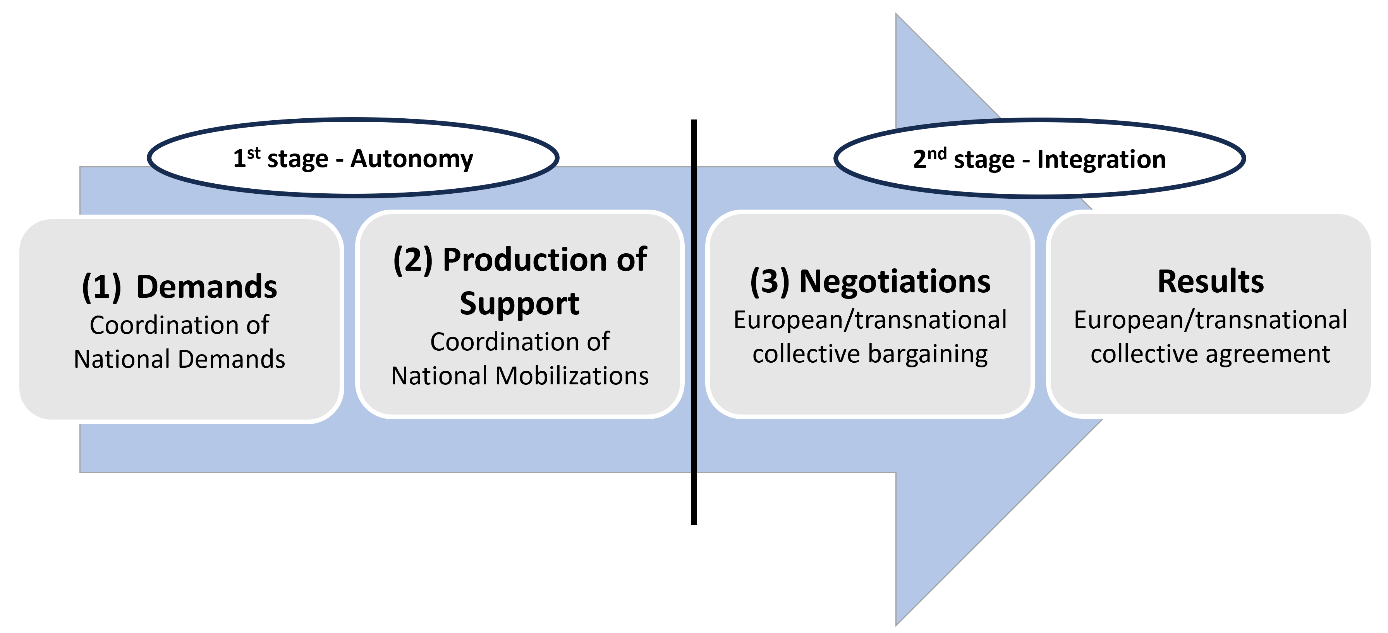
We are using the “production of the representative function of trade unionism” approach created by Jean-Marie Pernot (see diagram below) to better understand where we are in the process initiated by the couriers at the European Assembly which gave rise to the Transnational Federation of Couriers (TFC).
If we apply the “representative function production” approach to our case study on couriers at transnational level, we see that the first stage, that of the “autonomous” function, was triggered during the European assembly (see diagram below). The workers’ collectives or trade unions indeed made progress in the discussion over how to coordinate national demands (1, in the diagram). We can therefore identify this first assembly as a space for “autonomous” ideological production, which led to the drafting of a charter of demands shared by all participants. This presented an opportunity to forge a positive identity between actors from the different countries by sharing relevant information and drafting a shared strategy. Since then, the TFC has not moved on to a higher stage with a more binding structure on the basis of voluntary actions from its members. Although it could have allowed the common practices to be published and to bring about the progressive unification of bargaining agendas. And regarding the second sequence of the autonomous function, the production of support, in this exact case it corresponds to “coordination national mobilisations” (2, in the diagram). This is still in its early stages. Whilst the Assembly's working groups have submitted numerous proposals for coordinated action, with a view to supporting the demands of the common charter, this remains an essential challenge because European strikes in these sectors have not been taking place. Proposals for coordinated, decentralised action have yet to be strategically thought out and implemented.
On the other hand, we clearly see that the second stage of “integration”, involving speaking with a representative negotiating partner at European level, does not currently apply. Negotiating at European sectoral level would mean having already identified the employers’ side at this level. On the employers’ side, platforms would have to become members of an existing sector-level employers’ organisation or create a platform employers’ organisation themselves. At present, this seems unlikely given that one of the characteristics of their economic model is precisely to eschew their role as a social partner and to resist institutions of all forms and social legislation. There is then the question as to the conditions for European collective bargaining, not at a sectoral level, but at the level of each platform enterprise. On the trade union side, currently, the actors do not have the legal instruments needed to exert pressure on employers. The alternative would then be to dedicate a European law to transnational collective action which would have to be recognised in national law (therefore doing away with the national legislative limitations on solidarity strike action and striking in public services); but also, to demand an affirmation of the right to association, the right to bargain and the guaranteed autonomy of trade unions at EU level.
If European trade unions do not have the capacity to establish a position of strength in workers’ favour, it would obviously be very difficult for them to develop European collective bargaining to protect and reinforce their rights. This is why it is so crucial for the European trade union movement to have autonomy over their ideas and be bold enough to step forward as a player in the conflict. A first step in this direction could be the strengthening of “autonomous” players’ power as exemplied by the Transnational Federation of Couriers (TFC). This is the coordination of demands supported by transnational mobilisations which would be a way of reintroducing the reference to social conflict, which has disappeared from social dialogue. Forcing the employers’ side to appear as a negotiating partner would then achieve genuine European collective bargaining.
Production of the Representative Approach
The diagram below reflects how trade union representation is divided into two stages: autonomy and representation. Each can be broken down into two distinct sequences, but both are interdependent: (1) Demands; (2) Production of Support; (3) Negotiations; (4) Results.
Source: Based on the diagram by Jean-Marie Pernot, Syndicats: Landemains de crise, Gallimard: 2005: 269.
The drawing up of demands is the starting point as it allows the actors to surface the objective of acting together. The second stage is the process of mobilizing support for the demands. This encompasses various forms of mobilization. These two stages represent the autonomous moment and function of the trade union.
The third stage is a more typical trade union approach involving negotiating with a partner. It can be more intense that the earlier stages, in which case it may be possible to build a stronger position. The final stage, the result, concludes one cycle of trade union practice and initiates the next. These stages can be categorized as “integration.” It presupposes both trade union and employers’ sides that have been identified and willing to negotiate.
In totality, these stages of the representative process, autonomy and integration, constitute a dialectic reflecting the fundamental ambivalence of trade unionism.
Annex
Collectives and unions in the hot meal delivery sector present at the European Courier’s Assembly
|
Country |
date of formation |
Trade unions
|
|
Norway |
(03/2018) |
Oslo Transportarbeiderforening Transport trade union Member of the Fellesforbundet |
|
Switzerland |
Couriers’ collective (Geneva)/ UNIA (01/2018) Couriers’ collective No Time (Bern) UNIA |
UNIA
Media and logistics trade union |
|
Austria |
Couriers’ collective/Vida (2018) |
|
|
Netherlands |
(10/2017) |
FNV Federatie Nederlandse Vakbeweging Trade union confederation of the Netherlands |
|
Germany |
FAU Freie Arbeiterinnen- und Arbeiter-Union Free workers’ trade union NGG Gewerkschaft Nahrung-Genuss-Gaststätten Trade union for the hotel, restaurant, café and hospitality sectors |
|
|
France |
CAVAL (national), Coordination d’action Visant l’autonomie des livreurs CLAP (Paris), Collectif des Livreurs Autonomes de Paris Syndicat des Coursiers à Vélo de la Gironde Collectif des Coursiers de Lille Métropole (Lille) |
Syndicat CGT des coursiers unis dijonnais (SCCUD)
|
|
Belgium |
CNE- Centrale nationale des employés FGTB , Fédération Générale du travail de Belgique
|
|
|
UK |
Couriers & Logistics/ IWGB
|
IWGB, Independent Workers Union of Great Britain (Couriers & logistics Branch) (2015) IWW, Industrial Workers of the World (Couriers Network) (01/2018) |
|
Spain |
LAB, Langile Abertzaleen Batzordeak Nationalist workers’ committees, Basque Country
Central Unitaria de Traballadores (CUT, Galicia)
|
|
|
Italy |
(10/2016) (12/2016) (06/2018) (2017) Riders Union (Padova) |
|
|
Ireland |
|
IWW, Industrial Workers of the World (Couriers Network) (01/2018) |
|
Finland |
|
|
|
|
|
|
|
TOTAL |
24 = 14 city-level collectives + 10 collectives at national level |
17 = of which 5 sector-level federations (transport, logistics, logistics, 2 Commerce, Food) |
References
Abdelnour, S. & Meda, D. (2019). Les nouveaux travailleurs des applis. Puf/Vie des idées.
Aguilera, A., Dablanc, L., & Rallet, A. (2018). L’envers et l’endroit des plateformes de livraison instantanée: Enquête sur les livreurs micro-entrepreneurs à Paris. Réseaux, 212(6): 23-49.
Alderman, L. (2019). “Food-Delivery Couriers Exploit Desperate Migrants in France.” New York Times, 16 June 2019.
Cant, C. (2017). Precarious Couriers are eading the struggles Against Platform Capitalism. Political Critique, August. http://politicalcritique.org/world/2017/precarious-couriers-are-leading-the-struggle-against-platform-capitalism/
Cant, C. (2018). 2016-2017: La vague de résistance des travailleurs des plateformes de livraisons européennes. Politics Without Inquiry! 29 January https://notesfrombelow.org/article/european-food-platform-strike-wave
Dufresne, A., Leterme, C. & Vandewattyne, J. (2018). Les mobilisations du Collectif des coursier.e.s contre Deliveroo. Courrier Hebdomadaire du CRISP, 2383-84: pp. 45-58.
Dyer-Witheford, N. (2015). Cyber-Proletariat: Global Labour in the Digital Vortex. Pluto Press.
Freyssinet, J. (2019). Royaume-Uni. Les syndicats et les plateformes. Chronique internationale de l’IRES. 165 (March): 34-46.
Huws, U. (2014). Labor in the Global Digital Economy: The Cybertariat Comes of Age. Monthly Review Press.
Jehin, A. (2018). Coursiers à vélo et Deliveroo: les enseignements d’un combat social. Smart, 6 July. https://smartbe.be/wp-content/uploads/2018/07/06-2018-deliveroo_final.pdf.
Marinaro, P. (2020). I riders latinoamericani lanciano lo sciopero globale. Jacobin Italia, 28 August. https://jacobinitalia.it/i-riders-latinoamericani-lanciano-lo-sciopero-globale/
Piasna, A. & Drahokoupil, J. (2019). Digital labour in central and eastern Europe: evidence from the ETUI Internet and Platform Work Survey. Working Paper. December. ETUI. Brussels.
Srnicek, N. (2017). Platform capitalism. Polity.
Van Doorn, N. (2023). Liminal precarity and compromised agency. Migrant experiences of gig work in Amsterdam, Berlin, and New York City. In I. Ness (Ed.) The Routledge Handbook of the Gig Economy. Routledge, pp. 158-179.
Vandaele, K. (2018). Will trade unions survive in the platform economy? Emerging patterns of platform workers collective voice and representation in Europe. Working Paper. March. ETUI. Brussels.
- We will not develop here one other important strategy of struggle of app workers: acting on the law, especially at the national level. Here, workers have sought to obtain favorable case law which has paved the way for many on-demand workers, riders or drivers to be reclassified as salaried workers, thus rekindling the flame of salaried rights and protections.
- Ursula Huws (2014) uses the term “cybertariat” to denote jobs that assist production and are practiced on an interposed screen: the standardised tasks performed by individuals only allow them to develop generic skills, encouraging strong occupational mobility. For a classical Marxist analysis of the subject, see also (Dyer-Witheford 2015).
- ‘Glocal’ is reflecting or characterized by both local and global considerations, relating to the interconnection of global and local issues. The term “glocal management” was used in the business strategies of companies, in particular, by Japanese companies that are expanding overseas. "think global, act local" is also the phrase that the social justice movement in the US has adopted.
- Germany, Austria, Belgium, Spain, Finland, France, Ireland, Italy, Norway, Netherlands, United Kingdom and Switzerland.
- Srnicek (2017) distinguishes different models of digital platforms: between “advertising platforms” (e.g. Google, Facebook), “cloud platforms” (e.g. Amazon Web Service (AWS)), “industrial platforms” (e.g. General Electric, Siemens), “product platforms” (e.g. Zipcar, Spotify) and finally “lean platforms” (e.g. Uber, Deliveroo). Not all of them have enjoyed the same levels of success, but what they have in common lies in the centrality of harvesting and exploiting data to their business model.
- This last category presents another challenge, that of “identity borrowers”. They are minors or undocumented who, without a national number allowing them to register on the platform’s application, borrow credentials from anyone willing to lend them. These “sub-contractors” therefore only receive some (often a small amount) of the order, depending on how willing their lender is. To read more about this essential issue, see Van Doorn (2023)
- Two surveys were each carried out on approximately a hundred delivery workers working in the area of East Paris, one during October-December 2016, and the other during January-March 2018 (Aguilera et al. 2018).
- All of the quotations from workers which appear in the text are taken from the transcription of the debates at the EGA which took place in October 2018.
- Annex C: Collective and Unions in hot meal delivery sector.
- Norway, the Netherlands, France, Germany (two collectives), the United Kingdom, Finland and Austria. See details in the Annex.
- For a directory of all couriers’ collectives and unions linked with them per country, see the Annex. The German union is the Freie Arbeiter*innen-Union [Free Workers Union] (FAU).
- Domestic work platforms include, for example, Helping (https://www.helpling.fr/) or Upwork for casual labour.
- Unia is the largest trade union in Switzerland with 200,000 members covering almost the whole private sector.
- This section, a panorama of the courier mobilisations, is based on the article by Cant (2017), Cant (2018), enriched with first-hand accounts from trade union and collectives’ spokespersons during the GA in Brussels in October 2018.
- By way of comparison, the National Living Wage (minimum wage for the over-25s) entered into force in April 2016 at a rate of 7.20 pounds.
- Cant Callum, Deliveroo rider in Brighton and member of the IWW trade union, is a frontline observer. His work entitled “Riding for Deliveroo. Resistance in the New Economy”, recounts in detail the London movement in the context of burgeoning platform capitalism.
- We have also to mention that, in October 2020, following the epidemic, an international coordination body for couriers and drivers called Unidxs World Action (UWA) was set up. For more details, see Marinaro (2020).
- For more information about the two networks, see the ALTERSUMMIT website, http://www.altersummit.eu/?lang=fr et https://www.projet-react.org/en/
- Germany, Austria, Belgium, Spain, Finland, France, Ireland, Italy, Norway, Netherlands, United Kingdom and Switzerland.
- With few of them present at the GA, the cooperatives were mainly represented by Coopcycle which currently brings together about forty of them.
- For a list of actors, see the Annex.
- Just six months after the first assembly on 25 and 26 April 2019, a second couriers’ meeting took place in Barcelona. Organised by the collective Riders4Derechos, it was entitled “My boss is not an algorithm”. It saw the participation of couriers from Spain, Italy, the UK, France and Germany (FAU), but also from Argentina and Chile.
- The importance of the claim category to the FTC is assessed by the number of times it is mentioned as feedback from the four working groups in plenary session.
- It should be noted that the German FAU co-founded in May 2008 the ILC (International Labour Confederation) with militant trade unions from seven other countries (Argentina, Canada, United States, Greece, Italy, Spain and Poland) so as to strengthen ties in the same companies and sectors at transnational level, starting with the sectors of food, logistics and transport.
- Social dialogue is a procedure that takes place in a political climate marked by actors being represented as “partners” in search of consensus as a primary aim, which has clear consequences for the weakness of the texts negotiated since 1991. Moreover, at a sector level, it has been particularly in the spotlight since 2013, when the Commission refused to change a sector-level agreement into a directive (in the hairdressing sector).
- EFFAT, European Federation of Food Agriculture and Tourism Trade Unions; ETF, European Transport Federation.
- EFFAT and the ETUC also participated in the European assembly as observers.
- This eschewing is not a characteristic of platforms alone. It is a characteristic of “transnational employers” (regardless of the sector) who are always seeking to evade all forms of national regulation.