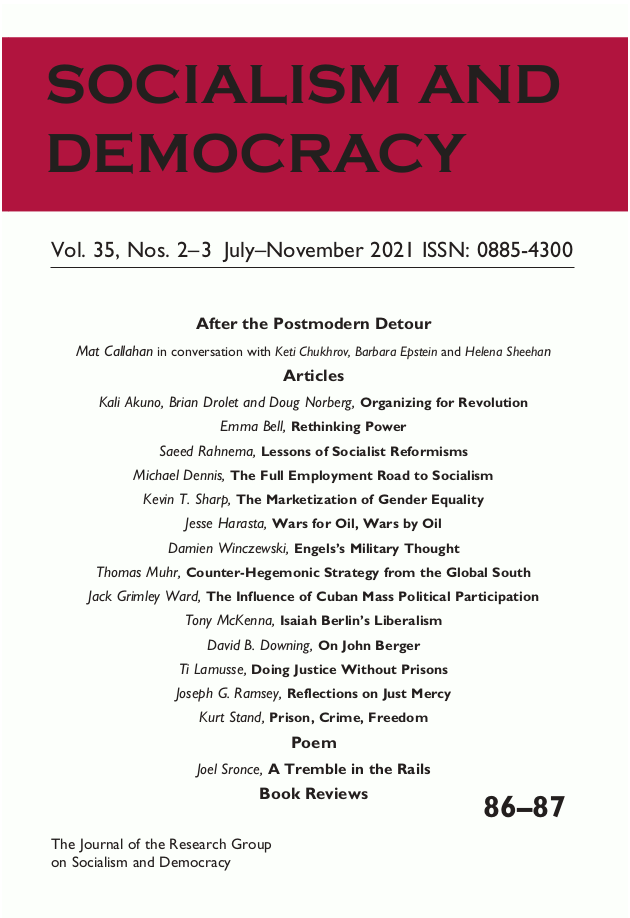
Keti Chukhrov’s new book, Practicing the Good: Desire and Boredom in Soviet Socialism, is a thought-provoking exploration of political economy, sexuality, aesthetics and philosophy as they were developed in the Soviet Union by thinkers such as Vygotsky, Ilyenkov, Platonov and others. But more than that, the book offers a stunning critique of Western interpretations of the Soviet experience and more specifically the ostensibly "leftist" or radical positions taken by thinkers such as Althusser, Foucault, Lyotard, Deleuze and Guattari, Butler, and others. As Chukhrov writes:
Disappointment in the Soviet socialist experiment eliminated all aspirations for a critical theory that would posit radical anti-capitalist measures—abolition of private property, complete socialization of education, equalization of the remuneration of labor, cultural cosmopolitanism, and universality--as emancipatory; instead, such measures were treated as coercive, immature, and totalitarian.
She concludes by saying:
By reconsidering the emancipatory concepts that 'traditionally' undermine power and metaphysics—sexuality, freedom, enjoyment, desire, unconsciousness, subversion, performativity, etc.—I call the liberating potential of such concepts into question. On the other hand, by revisiting notions regarded as metaphysical--such as the ideal, the universal (the general), the classical, metanoia, realism, culture, non-self being, and self-resignation--I trace their transformation into materialist social tools in the conditions of a non-surplus economy.
Chukhrov thus reveals, "the hidden capitalist core in the very subjectivity of anti-capitalist critique." Seeing the proverbial gauntlet thrown down, I asked Keti if she would join me in an in-depth exploration of the sources and implications of her work.
Mat Callahan: Thank you for joining me in this interview, Keti. Could you tell us what inspired you to write The Practice of the Good?
Keti Chukhrov: First of all, Mat, thank you for your interest, and I'm really honored that this interest comes from the West. My initial idea was not to argue with the liberal wing of the Slavonic thought, which is often framed by Cold War politics. It hinges mostly on the failure of the politics of equality. What I found more important is the dismissal of the socialist emancipatory achievements within the leftist context. More specifically, a leftist context that is a result of the Sixties in the West, closely identified with emancipatory politics, starting with the Althusserian philosophy.
Thereby, my focus was on how to differentiate what happens in Marxism in the Western context and in the socialist context, and why there is divergence in how each treats crucial emancipatory concepts, such as culture, consciousness, desire, the ideal, the libidinal, the real, labor, et cetera. Therefore, my interest was not only in exploring the Marxist cultural and philosophic context of this historical socialism, but as well to use these socialist texts as a litmus paper to retroactively check how ‘Western’ emancipatory critical theory after 1960s is reflected in this socialist ‘mirror’.
Usually, the approach is that the Foucauldian theory of sexuality or Foucauldian theory of cultural and historical archeology, or Butler's gender analysis or Deleuzian schizo-analysis, are universal tools of analysis and can be exemplary of emancipation in socialist and post-socialist cultures, too.
My initial question was whether we can use these critical instruments to analyze a system which worked differently. Initially the post-socialist agenda was: "Well, give us a little bit of time and we will adjust our post-socialist selves to ‘Western’ theory" - Deleuze, Foucault, Lacan, Castoriadis, and the whole bulk of Frankfurt School or Lacanian or post-structuralist thinking. Just to clarify: my attitude toward this context is very respectful.
My educational background consists of the above-listed theoretical edifices. Yet my question is: can we apply this post-war critical theory as an almighty tool to analyze or to emancipate the sociality, which was polit-economically and epistemologically so different? Further, if this sociality cannot be analyzed by means of post-structuralist tools, or, the tools of the so called ‘Western’ emancipatory critical theory, is this sociality lagging behind? This in turn raises another issue: how to reveal those specimens of modernity which developed in historical socialism as a project of alternative socialist post-capitalist modernity, which is in a way, according to my colleague Maria Chehonadskih, a post-critical modernity,one no longer dependent on the internal criticism of capitalism, because this modernity, to a certain extent, has surpassed capitalism.
Callahan: Let's talk about that in greater detail. You make a number of assertions, which I think are demonstrably true about what the Russian revolution actually did by abolishing private property. From that revolutionary transformation and its manifestation in law and the state, certain practices unfolded. You make the point that this question of practicing the good in the title of your book is really a reference to the common good as it was conceived of within the Soviet experience, the Soviet experiment, or whatever words you want to use to describe that whole process of 1917 until 1991.
I'd like to ask about the relationship of your critique of postmodernism, to those actual facts, those actual experiences, those actual activities. You have a basic premise of the common good, activity and labor, the abolition of private property, and specific examples from Soviet thinkers, Vygotsky, Ilyenkov, Lifshitz, and so on, that you refer to. Their work was actually done in the post-1960s period. Some of it earlier, but in the main, it took place in the very period that postmodernist or post-structuralist thinking was being promulgated in the West.
Chukhrov: Exactly. One of my observations was that in post-1968 emancipatory theory, the common good is often split. The Common gets separated from the Good. There are practices and agencies in terms of organizing the commons. Even Negri and Hardt's book was called “Commonwealth.” Nevertheless, the good was torn from the common. For example, in the work of Lacan or the research of Foucault, and generally in the post-structuralist research, there was serious suspicion about “the good.” Communization, the commons was always something affirmative, interesting and subversive, whereas the good represented some kind of false good, law or order. It was associated with power, authority, and with the impossibility to somehow appropriate this good for production, for development, and for commonness of this good. The good rather belonged to a certain kind of conservative forces, which are not progressive forces, which are not "we," and which had already been hijacked by a certain kind of big brother, big other, or whoever.
My question was why capitalist order is transformed into the viciousness of order as such. So even before exploring whether there can be some kind of emancipatory order, the idea of order itself, or the idea of the good itself is already rejected as some sort of control, as some sort of sublime umbrella over our freedoms. Even in the treatment of the socialist utopia and utopia generally - the idea that things can be de-alienated - this idea causes huge suspicion. Some of my colleagues would insist that the attempt to overcome alienation, even if only on economic grounds is suspicious. This is because alienation is an ontological form of organization of being. We cannot surpass alienation. Negativity is part and parcel of being.
Meanwhile, what was interesting for me is that something that we treat as the nihilist rule of being according to Marx, might be simply the consequence of a specific forms of political economy. Something that seems alienated and appears thus the rule of alienated being, - and is experienced as the impossibility to practice collectivity, or to organize sociality according to the common good, was the consequence of concrete measures of economic politics. This was actually the discovery and invention of Marx, that libidinality, or a certain sort of private desire, or the individual desire, or the narcissistic striving towards surplus enjoyment is not some kind of ontological rule, but it is a consequence to a particular kind of political organization that hinges on surplus value.
As long as one coercively gets rid of surplus value as the component of economics, one might achieve the transformation of being. Not only sociality, not only types of production, not only types of labor might then be transformed, but the abolition of private property is able to transform the very essence of being or even the mode of existence of material objects, and, consequently, the epistemes or the forms of knowledge and the forms of organization of knowledge.
Callahan: Let me just add, that there's a context for that. Meaning: the United States and its allies were at war with the Soviet Union. That's a matter of fact. And they never stopped the war from the time of 1917 on out, they were at war either militarily, economically or ideologically with the Soviet Union. That was a constant until the very end. In fact, it continued after the collapse of the Soviet Union.
In other words, they sent their economists and their philosophers to educate you and get you to conform to the Western way. In some ways, this discussion is actually part of that ongoing struggle, because it seems to me a lot of the questions that were posed by the Soviet experience were in fact questions about the future: Is the future actually the abolition of private property? Is the future actually the common good? Or is the future more possessive individualism, more capitalism, better capitalism, that's more technologically advanced and so on?
Chukrov: That's a fantastic question. Your question is very properly put. In the Fully Automated Luxury Communism by Aaron Bastani, the idea of the commons and communism can be achieved by means of abundance and overcoming of scarcity. There were lots of critics that found the socialist experiment a failure precisely because it amounted to scarcity, to modest economics, to some kind of commons of poverty, instead of insisting on the commons of luxury, which Aaron Bastani speaks about. Yet, the problem is that once we adhere to the idea of abundance, we then have to evenly distribute the surplus. In that case we do not get rid of the logic of surplus, of the hegemony of libidinality and desire.
The paradox of the logic of desire and surplus value economics is that, the more we extrapolate our desire of abundance, the more there are possibilities for the marginal and dark zones of scarcity to appear. This is the way desire works. It can not cover collective needs. The logic of basic need works differently. Although the organization of the economy through basic need could be coercive, paradoxically, it could eventually lead to a circumscription of enjoyment. The stake is not at all to limit enjoyment, but to apply the basic need logic as long as it constitutes the idea of the commons. Then you are absolutely right in asking, whether such logic could be the future wish of humanity.
This is the reason why another argument of mine was that the common good might be unbearable. It might not be implementable or acceptable for certain groups of sociality. Therefore, I wouldn't be able to answer what the future of humanity is: the basic-need economy? Or luxury for everyone, as Aaron Bastani suggests, saying that the future acceleration of technology can bring the planet to a post-capitalist commons.
Callahan: There's a basic ontological question, which is the ontology of ownership. If you pose the question of "I am because I own," versus "I am because we are," you have an irreconcilable split, and according to capitalist logic, "I am because I own."
Chukhrov: Yes, absolutely. Also, according to capitalist logic, "I am, because I love the love of myself,” according to the wording of John Roberts. Now what does the term libidinal mean? It's not simply some sexual attachment to somebody or something, but it's a certain virus which organizes being according to not merely the love of wealth, but “the love of the love of yourself,” which compels you to persevere with owning, to persevere with organizing the imaginaries, which foster owning. One cannot stop the race of new acquisitions, as one is dependent on the phantasmatic and narcissist images of oneself. This is not even so much about ownership, but ownership is the consequence to this fantasy of oneself.
Therefore, in Soviet socialism, the initial idea was to somehow circumscribe this attachment to the self and attachment to the love of the self. Even, in terms of acquisition of achievement in sports, acquisition of achievement in the arts, acquisition in achievement of owning something. If you achieve something in art, this is everyone's good. If you achieve something in sports, this is everyone's good. Therefore, you would not become a billionaire because you won the competition somewhere, or invented something. You immediately delegate your achievement to the public, to everyone. As your achievement is valuable precisely due to belonging to everyone and not because it's your acquisition and your excellence.
Callahan: And those two are completely irreconcilable. And the point is that that's why the West had to crush the Soviet experiment. There's no question about that, historically. The problem is philosophically—and this is what your book gets into--the question has arisen again. You have a climate catastrophe, you have a pandemic, you have a financial crisis, and you have endless war. This is what capitalism has given us in the wake of the collapse of the Soviet Union. Thank you! Thank you! We now have our libidinal economy played out in real life terms where everybody is paying the price.
So, this is where this question of critiquing the critique becomes so important because in the West, the Butlers, the Foucaults, the Lacans, and whomever have become very fashionable and have dominated left-wing thinking for a long time. Even though they actually have nothing to show for it. They have nothing to show for it, except for academic careers. People have made careers, become famous, they've made money, they sell a lot of books, but as far as actually emancipating anybody, I'd like to know what they've accomplished.
Chukhrov: Before I answer your question, I would mention that with the pandemic, many thinkers came up with the idea of becoming more modest. There were many voices such as Bifo Berardi about the basic need economy, calling for sequestering the carnival of incessant desire and enjoyment. But very soon it became clear that all forms of enjoyment inaccessible offline had already shifted online – acquiring the forms of inventing one’s own narcissistic selves.
In other words, surplus economy, even if it's not a concrete representation in body, transforms in the virtual world and gets monetized. The belief that internet will bring us the new commons, de-privatized or de-monetized, did not come true: Instagram is privatized, Telegram, which was initially free from the private economy and control, is more and more manipulated and privatized too, to say nothing about Google or Amazon.
Concerning what you said about post-war critical theory that was so brilliant in academic achievement but did not bring us sufficient achievements for our social good, on the one hand I agree, on the other hand, this theory was somehow composed to teach us to deal with negativity. To teach us, how to deal with things when they are not resolvable.
For example, negative aesthetics and negative dialectics of Adorno taught us how to remain avant-garde when a true social avant-garde is impossible in the absence of social revolution. Lacan and psychoanalysis taught us how to deal with reality when it is only an illusion of reality, and so on. I would therefore pay proper tribute to all the critical edifices since 1950s—from Lacan, Adorno, Deleuze, Derrida, etc.—that invented the tools of dealing with social negativity and had to use the transgressed negativity as the tools of resistance in the absence of the proper tools for “Hard” emancipation.
In capitalist sociality, this path of appropriating alienation and speaking its lexicon is inevitable. This is why even Ernesto Laclau and Chantal Mouffe as theorists of social democracy rely on negativity as the principal critical and transformative tool. For them, social democracy is about keeping the tensions of agon [Greek for “contest” or “conflict” ]and sustaining public negotiation as sober tracing of negativity in society. So, as long as sociality keeps this vigilance tracing the negative components of sociality or performs its own negative agency within sociality, it is alive. Such an approach is indispensable when we confront right-wing governments, or the conservative politicians that tell us "Well, everything is in harmony. Everything is good. Our state is thriving," et cetera.
In that case, we are, of course, in need of critical negativity to confront the false harmony by this resisting tool. It is in this sense, that all the above-mentioned critical tools of the continental theory were productive. But, they cannot be compared to Leninist decisionist methods. Moreover, they would be unable or reluctant to deal with the consequences of political decisionism. The Leninist decisionism can definitely be seen as coercive as it did not be consider the interests of the privileged layers of society.
For instance, when Lenin and Krupskaya decided that the kids of peasants would study together with the children of the enlightened bourgeoisie, this seemed unacceptable even for some leftist activists. Imagine your children, who speak different languages, play the piano, know art and culture, studying with the kids who can hardly write and read? This was difficult to accept. But this was also a coercive political decision.
So was the act of criminalizing extraction of profit – i.e., private ownership of the means of production in general. Of course, such measure can be accused of not allowing “free” citizens to extract profit out of their business. This could even be regarded inhuman according to many thinkers.
Callahan: You're being extremely gracious to thinkers, that are in my view reactionary. So, in other words they're not...
Chukhrov: Well, saying that they are reactionary might cost one a career.
Callahan: That's an interesting point because that is their coercion. In other words, you may not physically go to the gas chamber, but you will definitely never get published.
Chukhrov: Well, I would make differentiations here. Because, even though, now, with the failure of certain emancipatory modes of critique, some of those figures are less convincing and appear as the proponents of bohemian decadence rather than champions of social emancipation. Still, they had to evolve in this direction out of social desperation. The desperation with the neoliberal state and inability to solve its vicious traits. This is why it was important for me to observe in these edifices the latent desire for capitalism, which has not been acknowledged and articulated.
Callahan: That's an important point. That's extremely important. We should look at that a little more closely. I use the term, “reactionary.” I should qualify that. I don't think the term applies to every single person we have mentioned. I can understand the shock of Adorno facing Hitler, and facing exile, seeing all of their cherished ideals smashed, and losing any confidence in the future. I can understand that.
But the period you're really talking about is post-Sixties. It's after the revolution of 1968, it's after all of this huge turmoil in the world. It's in a period in which the United States is regrouping from a very serious defeat in Vietnam. They had suffered an epochal defeat and they needed to regroup. That's when they brought in Reagan and Thatcher, and this whole neo-liberal concept. They needed left-wing sounding thinkers to make it appear that this was part and parcel of a new beginning. "We're going to get rid of the communists over there, and we're going to deliver you better capitalism, new and improved capitalism. And, it's going to be new and improved by all of these new ways of rebelling. So, you can rebel, you can be transgressive and you can be successful at the same time. It's back to Nietzsche, the will to power...
Chukhrov: Yes, I agree with you, but these beliefs of the cultural left in regards to influencing overall social transformation failed with Trump, right? And, we see that social democracy as the improved and balanced mode of capitalism, is declining. And, we are moving to austerity capitalism, reminding us of feudal forms of ownership, and feudal forms of extracting profit out of financial excess, rather than the idea of capitalist production controlled by civic institutions and society. On the other hand, I would say that personalities like Deleuze and Lacan would never acknowledge that they were governed by or guided by, say, the neoliberal Chicago Boys, for instance. This is because, they believed that the modes of subversion they advocated would allow us to achieve social independence, or hegemony – as Laclau and Mouffe would put it. My question is more about the reasons and motivations why these thinkers were un-attentive to the Marxist theory that was developing in the context of historical socialism. For instance, Althusser articulated his reasons to completely delink with any emancipatory contextualization of the Soviet social experience as early as in his “Essays in Self-Criticism” (1974).
Starting with Stalin and even after the Thaw, the Soviet socialist experiment and its epistemology is seen as a fake. This is understandable, as it was hard to believe that after Stalin something emancipatory would survive. Yet, for example, Evald Ilyenkov’s point (and I agree with him), was that the revolutionary transformation was so powerful, that its emancipatory achievements could not be overshadowed, not even by Stalinist repression. So, certain gains of revolution were intact even within the Stalinist years. They somehow preserved themselves, and developed in the post-Stalinist years. So that it was in the Sixties and Seventies, that the system revealed articulate capacities to construct sociality according to this basic need logic. One can say, that along with the shadow economy and the seduction of the capitalist life-styles, the 1960s also brought about the experience of socialist modesty as wealth. Huge numbers of people got used to this modesty, and they were treating modesty as wealth.
This is when not to be rich is a proper wealth and pride, because one, for instance, would not be able to write a piece like Beethoven’s 9th Symphony being an owner of big wealth. But even if one does not compose anything like the 9th Symphony, one wants to exist in the cosmology, where such a thing as the 9th Symphony and its emancipatory striving could be crucial. And, then this virus, which is constantly, libidinaly seducing me into imagining my luxury house, my car, my success; so, that art is a complement to my success, a complement to my imaginary about my beauty, and my, I don't know, my thriving, et cetera. It's the other way round.
That's why I like Badiou’s notion of the proletarian-aristocrat: the proletarian is an aristocrat because she doesn't need to enrich herself and enhance her capital; s/he is an aristocrat because, s/he is already wealthy, despite modest living conditions. Feeling the commons as one’s proper wealth is a completely different type of value than surplus value.
Callahan: Right. The core contradiction is expressed in a peculiar facet of the English language—we have words that express two opposite concepts—for example, “belonging.” “Belonging,” as in ownership, or “belonging,” as in membership. And, the wealth of the commons is belonging, as a member of the human species, belonging to this society, you are member of this group, and you are happy and joyful in celebrating that. Whereas belonging, I own this, this belongs to me, is the capitalist ethos, period. There's nothing else more important than this belongs to me. So, the thing that really strikes me is that, from Althusser on down, these people failed to see that people like Ilyenkov, Vygotsky and others were actually producing very good work.
At least it was worth being considered. And, some of these people I never heard of until this year. And, not just your book, but a few other things have leaked out. So you have to ask, just on the level of intellectual honesty, why were these things prevented in our "liberal," "open," "free," West, from being published? Why didn't we read about people who had a completely different attitude? In fact, an anti-Freudian attitude, that were practicing psychology, studying the education of children, and so on. And, developing theories that were certainly worthy of being debated. This whole question of consciousness, and the materialist dimension of the ideal that you explore in depth; these things need to be discussed, and they're just as vital now, if not more so, than they were at the time. So, one has to ask, was it really that Althusser, and others like him, were ignorant of these things? Or did they deliberately...
Chukhrov: No, they were not ignorant. My very direct answer would be that they couldn't even be aware to what extent they are permeated by the unconscious capitalism. Quite like each of us today. For instance, for a capitalist subject, the abolition of personal enjoyment means a totalitarian control of me or an imposition on the part the idealistic self. This was Freud's path: everything that is sublime, and everything that is ideal is some kind of imposition from an authority. Likewise, for Althusser, even the construction of the subject is interpellated through the state, and ideology. For Ilyenkov, Vygotsky or Leontiev, the language, the general, consciousness, the universal are not that suspicious. For example, the pedagogue who teaches “me,” and does not spare her capacities and knowledge to share with “me” her zeal might not necessarily be "authoritarian" or repressive. And our trust does not cancel the possibility that the pedagogue can as well be criticized.
Then language is understood differently than in a post-structuralist theory – not as authority, but rather as social sharing. In post-structuralist theory language limits and alienates and hampers creative potentiality, therefore emancipation lies in subverting it, we have to constantly de-signify and alienate its structure further. The classical case of such an approach in contemporary culture is Paul Preciado (among others). For him, indulgence and surplus pleasure equal emancipation. In the frame of conservative hypocrisy, libertinism indeed plays such an emancipatory role. But I would rather follow Marx’s route of critique of the lumpen bohemian in his The 18th of Brumaire of Louis Bonaparte, which argues that indulgence and libertinism do not mean emancipation by definition.
Transgressive forms of enjoyment can subvert certain kinds of control, but at the same time, they do not lead to the common good or solidarity. Rather they exert alienated viciousness in a creative and performative way. Such were some of the direction-defined performative experiments of the 1960s and 1970s in art and culture.
Callahan: There's also a periodization required here, because there was this tremendous explosion of the 1960s, followed by the restoration of imperial command, which took place in the late 1970s and is signified by Reagan and Thatcher. The restoration continues into the present day. And, in the 1980s, in particular, in the West, you did have a lot of performance art, punk rock, all kinds of negative rebellion, ugly is beautiful, and so on. I participated in that myself. I was very...
Chukhrov: If I were to treat it as capitalist culture, my comrades wouldn't agree with me, because punk culture, is definitely the culture of militance and liberation. Whereas for me it is more a counter-culture, than the cultural project of social engagement or emancipation. Anyway, I don't have the remedy to resolve this issue for the moment.
Callahan: But I think in that sense, it's not so much the remedy right now, as it is at least having a concept that the remedy can exist. And, that's what the common good represents. And, your description is quite accurate, because it's point-by-point the things that were excluded. In a situation in which people are desperate, and there is great hypocrisy and suffering, they're going to find forms of expression that are negative and are against that suffering. But, these are not necessarily promoting an affirmative future. They're simply against what they're suffering from. And, that's what a lot of that was, in the 1980s and 1990s in particular, it was negative. Sure. Because, people were pissed off, people were angry, and they were...
Chukhrov: Yes. And, of course it was anti-capitalist, but there were no tools to truly be outside capital. So, there were no remedies, and no cognitive specific instruments to get out of it, yes.
Callahan: Right. But I think that's why some of these ideas that you're bringing up are so useful now, because perhaps nobody would've listened to you in 1980. Of course, you were only 10 years old. But, I mean, they would not have listened to Ilyenkov or to Vygotsky, or the critiques of Freudianism, or the completely different approach to these questions that are simultaneously philosophical, economic, and educational. But, now perhaps these ideas can contribute, because we've come to the end of a lot of this negativity. It has not produced the desired result, which is freedom for people, or liberation, or whatever word you want to use. If anything, it's just shown that we need something else.
Chukhrov: Yes. But, it's also very much dependent on the construction of human desire. In the Soviet Union, for instance, the system was far ahead of daily life. I mean, the system was organized so that it was fitting sociality much more than concrete life-styles. People had concrete personal interests and desires not fitting general socialist aspirations. One of the chapters in my book is about the B-class Soviet films, which were mostly focused on the self-critique of one’s insufficient socialism; on the censorship of one’s hidden capitalist desire. Therefore, the huge bulk of this critique was some sort of philosophical analysis, reminiscent of Plato’s dialogues putting the question: why am I not the proper communist? Why is communism so remote?
Such questioning was not simply rhetorical but could reach the intensity of tragedy. It was in a way a question of Ilyenkov’s philosophy. Ilyenkov committed suicide in 1979. He cut his throat with industrial knife. He entered the kitchen and told his wife, "Olga, I killed myself." So one can imagine this as some kind of Socratic death of a philosopher in the socialist society where the party nomenclatura is no longer communist and truly Marxist; yet there remains the obsessive necessity of persevering with communism. The system is communist, at least nominally, but there are a number of representatives of bureaucratic apparatus or even laymen, who already dream and fantasize about capitalist life.
It was them, who eventually formed the Yeltsinist team to decompose the system from above between 1989-93. In 1991, after the Putsch against decomposition of the USSR, Yeltsin takes over from Gorbachev, but then in 1993, the parliament and people, reject capitalist reforms and Yelsin’s presidentship, to be mercilessly suppressed by him. The last suppression of pro-socialist discontent takes place in 1996 when the Communist Party wins the elections, but “democratic” forces rely on the support of oligarchs to fabricate the results of the elections and “save” Russia from the ‘red’ scenario. Thus people demanded the return of socialist formation in 1993, in 1996, and confirmed that they didn't agree with the overall privatization, while the new elites were engaged with primitive accumulation and the fight for resources.
Callahan: That's the way the West won. And it's very important what you're saying particularly about Ilyenkov and Socratic demise. It's tragic on an epochal scale, it's very much like Socrates drinking the hemlock.
Chukrov: Yes, absolutely.
Callahan: But that's exactly the point because if we go back to Plato as one of the originators of philosophy and his requirement of the abolition of private property. When he was asked to prepare laws for, I forget which city he said, "I'll do it on the condition that you abolish private property." So this is a basic philosophical concept along with the concept of communism. And along with the concept that until all humans are philosophers, we will not have communism. So this is the basic idea of philosophy and what pits it against religion. However, at several points in your book you refer to this self-criticism in art or the rejecting capitalist desire, is somewhat reminiscent of certain strains of Christianity, the small sects that left Europe and came to the United States to set up these communist communities, the Amish, the Mennonites, the Hutterites and so on. Their vision of Christianity and unity with God was self-denial.
And we belong to the common good... In our community, everything belongs to everyone. There is some kind of a connection there, which makes this question universal. You might say the fact that these thinkers come back now, in this reality today, they become part of a timeless dialogue, which really goes back to the origins of philosophy as a challenge to this kind of stratified society where a certain group has everything and the rest have to labor for them.
Chukrov: Yes, indeed. But you know, there's a saying from André Gide who said that, "If Christianity were successful, there would be no communism." Badiou’s book on Apostle Paul, is also not about a religious figure, but the one who establishes universality as a value, as the condition when there is neither the Greek, nor the Judaean, but each is anyone. It's the radical move against kinship, nationalism. And I think this is the idea of the Socratic Polis also. The political Eros is possible between any, and this is what could be common maybe between Christianity, communism and Plato’s polis that this open political affection is possible not between kins, not between relatives, not between people of different genders, men and women or people who are attracted to each other by love, but between any.
In Christianity, agapé (and not philia) is the type of love called unconditional. This applies to certain kinds of political movements that are not conditioned by party or concrete political alliances. In a certain sense, a communist party which has always been blamed for being a one-party organization, was in fact a sort of a post-party.
Callahan: The other problem of course, is that there are clearly antagonisms between how Christianity or Islam, which are both Universalist religions and have billions of members, how they envisioned the common good and how they envisioned, what, in a certain sense, would be called communism, the sharing of everything amongst all the members.
Chukhrov: In contemporary Christianity the commons resulted in being confined to church mysteries and parish communities.
Callahan: The point here is that there are longstanding demands, or you could call them desires of human beings. And when you're caught in the vortex of oppression and suffering, war, whatever condition it is, and you're struggling to find a way out and you're struggling to find some kind of resolution, sooner or later, you're going to come upon this idea of what is in the common interest. What is in the common good? How do we make a society that is not at war with itself? And so for at least a few thousand years, this is clearly what's been driving all of these social movements and they all have this element within it. And I've used the term social movement in the broadest sense, revolutionary, religious, whatever. And I think that the great virtue of what you're talking about and the contributions of some of the people that you refer to is that they survived the difficulty and the contradictions of a, you might say, corrupted or not completed revolutionary process. And were able to produce work that shows that it is possible, and that there are possibilities within that framework that are actually greater than any that are produced by the so-called advanced West.
Chukhrov: I would agree. Another thing that I would like to mention is that the abolition of private property might be very powerful because it can transform how we look at things. For Ilyenkov for instance, political economy was not only confined to economy, as well for Marx, analysis of capital was not confined to productivism or a difference between relations of production and productive forces, but political economy implied its philosophic dimension realized in daily material life itself. Why? Because deprivatized economy allows an object to become a noumenal object. The goal of philosophy since Descartes was how to unite idea and thing. This is the core question for post-structuralism too, but it did not manage to effectuate this convergence.
Therefore, they preferred to get rid of things looking upon them as any signs among other signs, inscribing both the plane of the signifier and the signified into semiology. If things are quite the same as signs, one can make performative assemblages and series out of them. But the Ilyenkovian argument was, “No, guys, things are important, but ideas are also important. And there are very complex dialectics between them.” The huge task of philosophy is to make them connected. Meanwhile, in the commodity, the connection between thing and idea is obstructed. The bank note is an absolute realization of this split between thing and idea.
It costs nothing as a thing, but it costs everything as a sign. We can see this in contemporary art: you can make a can of soup art. Although, I very much like Andy Warhol and American pop art, it's nevertheless the embodiment of this financial obstruction and the gap between its inflated value and actual absence of value. An absolutely "profane" thing and its extrapolated value. And this is what happens with the commodity generally. So my reading of Ilyenkov was that without abolition of surplus-value economics, one cannot perceive the world. But this is consistent with Marx’s view when he argues that the fetishized forms of a commodity result in our contorted perception of the world.
Callahan: Well, would you say that Ilyenkov was able to come to that conclusion or to articulate that thought because of the experience that he had? In other words, he saw the result of abolishing private property? So he was able to extrapolate from direct observation. In other words, it wasn't just abstract. He sees something happening in society and he comes arrives at a conclusion.
Chukhrov: Yes. When I sometimes rely on my memories, people tell me, one cannot refer to them in theory. Yet in this conversation with you, I would bring up my memory of a very specific habit of experiencing a material object in socialist conditions. It’s neither good or bad, just drastically different in its semantic realization. You have the same world, but if you use another perspective and logic of treating it, it all changes. That's why I used Agamben’s term of halo (oreol) in this connection.
Callahan: Well, that's where the Metanoia comes in. I think that's an extremely important concept as well, the whole thing of turning around. Turning around, turn around and see. But people won't turn around because their eyes are fixed to the screen. They are absolutely fixated on what's in that iPhone and not what's going on around them. And what Ilyenkov was seeing was something that was after that, that comes later, when you've actually abolished private property. And that's such a radical concept, people have difficulty grasping it. Yet in spite of the difficulty, people were denied. We, in the West, were denied access to what was really happening in the Soviet Union for all of its flaws. All that we were told was that it was terrible. It was totalitarian, it was bad. This was the “Evil Empire.”
And so, regardless of what might have been wrong with it, we were denied what was actually productively emerging from it. And particularly in the realm of art and in the realm of philosophy and childhood education, these things that you talk about.
Chukhrov: Another aspect of the economics of basic need, if seen from the perspective of capitalist prosperity, is of course the experience of squalor and misery. Discovering that the capitalist world is fascinating and attractive caused suffering in a socialist subject. That’s the reason of such a focus in film and literature on the act of metanoia that had to help to get rid of such aspirations.
If we look at the commodity from the point of view of laymen, commerce and profit are also some kind of common good. Commerce can be seen as the nature of human beings. We have the habit of exchanging things. A peasant has been growing something in his garden and then selling it to have some surplus and to enjoy this profit in order to buy something else. How to deal with this? Lenin had an understanding of it when he established the New Economic Policy. But it immediately resulted in new wave of inequalities, that was hard to mediate.
So, the socialist economy with its shortages might as well appear as misery. Hence, the controversial feeling of being content with equality, but suspicious about the opportunities of broader choice.
Callahan: There are a couple of terms or concepts that you use that might help us in the West grasp these dilemmas. I think it was Leontiev who wrote about activity and labor. This is central to the answer because in my own view, speaking for myself now, music is an activity. It's not a product. It's something you do. The same thing with athletics or with dance, or with any other form of art. And in the capitalist idea, it is a product that has to be bought and sold. In fact, it has to be owned intellectually. That's why they have intellectual property and copyright. There must be an author.
And so you have professional sports where everybody comes and buys a ticket and sits and watches, et cetera. But the activity and the labor is what everybody do. That's what everybody is capable of. Generally speaking, most people and certainly most children enjoy making music, dancing, playing sports, doing art, participating. This is the process that's emancipatory and educational. When you were writing about that, I was thinking, "Yeah, this is it." Okay, it doesn't answer all the questions that you just posed about “misery” under socialism or comparative wealth. Those to me, have to be discussed in a different way. But the questions that were posed by this question of activity and labor, by Leontiev, and a couple of other references that you made. First of all, they are universal. They apply to all people anywhere, and they certainly could be compared. Meaning, were people enjoying themselves, were they expressing themselves? Were they sharing or were they complaining, whining, crying? I don't like it. I want my freedom. What was happening?
Chukhrov: I think both. Because of course there were movements of leftist dissidence, which were very soon overtaken by liberal Anti-socialist dissidence. There was as well cultural dissidence turning its back on “official” culture and ultimately to Marxist philosophy. Later on the protest revealed itself in pop-culture and in the appeal for the freer forms of entertainment. For instance in the beginning of 1980-s the young people associated drugs, night-clubs with social emancipation.
In 1983 Georgian students from renowned intelligent families hijacked a plane, they had to shoot some of the hostages, the four hijackers were sentenced to execution by Eduard Shevardnadze. This was a tragedy and became the symbol of the future demise of the Soviets. At the interrogation the young people said they hijacked the plane to live in the West for the sake of joyful night life and liberties. So, in a certain sense socialist activity presupposes an “innocent” subject who is a “philosopher”, who needs nothing but common good. But are such creatures a majority in society?
Meanwhile there is always someone who imagines that the shadow economy can bring them supplementary profit (In the Soviet Union there was the term “the Under-the-counter trade”). These shadow areas of production were confirmation that the system was not encompassing all. Hence such important traits of Soviet sociality as double thought (dvoemislie) as the form of hesitation. One might be communist on the surface, but the question was whether one is a communist “behind the stage”. Hence the sacramental question: to what extent we are inevitably capitalists subjects?
By the way, Evald Ilyenkov often emphasized that vulgar communism is when you coercively end private property, but it's not enough, because the erasure of capitalist economy should be voluntary. Society should be ready for this deprivation. Or rather people should not treat the abolition of private property and profit as deprivation? But then he adds something very important: he says that without this first coercive step, it would not be possible to reach the further, more conscientious stage of communism.
Marx believed that only the developed capitalist societies would come to socialist revolution. Yet, historically it was in the poor countries that this happened. This because in wealthy developed countries capitalism finds different subversive ways to keep its power. Vijay Prashad, a political theorist, emphasizes this, pointing to the exchange between Marx and Vera Zasulich in which the question of communal forms of property ownership in relation to the necessary conditions for socialist revolution are discussed.
Callahan: You're talking about the Soviet experience. How much do you think that this applies to China, to Vietnam, to Cuba, all the countries that at least attempted some kind of socialism? I know that they're all different but in the sense of the universal and the conflicts that you're describing.
Chukrov: It really applies to a considerable extent to those Eastern countries as well but it depends on the type of analysis. Because there was the type of Slavonic critique, Slavic studies in Poland, in the US, in the analysis of the Eastern context. Like it's the end of socialism and it's liberation and we are part of Western contemporaneity.
And this was also coming from the leftist point of view, from a liberal democratic point of view. But now there are more and more books for instance, the analysis of Soviet modernist architecture and socialist architecture from Owen Hatherley, he's British who describes socialist architecture as a very progressive one and not necessarily something awful. This contrasts with Henri Lefebvre who, as my colleague Michal Murawski writes, said, "socialism didn't produce any new architectural spaces," and that's why socialism is not relevant because it didn't produce new spaces. Which is wrong, of course, it did.
But now people do not agree with Henri Lefebvre, ideas that developed in the Sixties. Now, they come up with the idea that yes, the Eastern Bloc was also quite progressive in its socialist aspirations. And it appears only now because it was impossible to come up with the progressive aspects of Eastern socialism in the Nineties, in 2000, even in 2010. And it's only now that for instance former Eastern German, Polish, or even former Yugoslavian researchers are beginning to ask to what extent were there progressive, emancipatory things done. So it's really new.
Callahan: That I understand, but do you think that this relates to experiences or similar let's say conceptualization in China, Vietnam and Cuba. Cuba still maintains that it's a socialist country. So does China as a matter of fact.
Chukrov: I think it relates to Cuba, but with Cuba we should remember that Cuba lives under the extremely harsh conditions of embargo, right? So, Cuba is always becoming the scarecrow for left liberal or liberal critics saying look, people have shortages of food. As long as you have shortages of food in this society, then nothing is relevant. No socialism can justify the shortage of food. And therefore I wouldn't dare answer this because I don't have enough research. It would be really arrogant to say something when I have never been in Cuba.
Callahan: That's fine. I just think myself, and again this is a Westerner talking, that people look at socialism not only as the Soviet Union, they look at socialism as Vietnam, as Cuba, as China. China continues to claim that it's a socialist country. And so, they make comparisons with the capitalist West, the same ones that you are making, but they're not confined to the Soviet Union. That's all I'm saying is that there-
Chukrov: I wouldn't confine this to Soviet Union. I would have reservations about China because they have a very specific new model nowadays and I need more research about China.
But what resonates with what you said in terms of Cuba and Vietnam is that... why these societies are poor and they could be wealthier, because they exist in isolation. They exist in extreme hostility and therefore they spare and waste a lot of money, as the Soviet Union was wasting aid for military protection or how numerous other countries spend their resources dealing with sanctions, embargos or other restraints.
So, these are extreme forms of existence. When you exist surrounded by the capitalist influence, you exist in extreme conditions. So we also should have in mind that when socialism is censored or it didn't have this and this and this, we should have in mind that it was also extreme conditions for preserving the socialist gains.
Callahan: Right. I'm actually not so much concerned with the particular, the thingness, the noumena, here. I'm thinking more about the fact that you have a society which has done some of the things, the belonging to, the membership in, the sharing... When you have 28,000 Cuban doctors going out to help-
When you have a society in which people can be proud of the fact that they are all literate, that they are all protected with healthcare and education and so on. And so, yes, there are certainly going to be dissidents, there are going to be people that want capitalism, they want to move to Miami and all the rest of it. But there are still in existence those people who share exactly those things you described about actually existing socialism in the Soviet Union.
In that sense of self-denial, self abnegation, the common good as being something that is beautiful and that's something-
Chukrov: Free education, free medical care and free housing. This is something that is guaranteed. And I know lots of students of mine who say that we would prefer free education, free housing and free medical care to 10 pairs of shoes, cheap shoes that you can buy and then you can change them every day and you can have just another 20 pairs of jeans.
Whereas in Soviet Union it was the other way around. You could have free apartments, which you are not hunting for but then you would think I don't want to buy this coat because it's not that nice coat which I saw in that French film. So, I'm destined to wear this very very, I don't know how to call it, very plain something on myself for the rest of my life but I will have free education and free medical care and I'm protected, yes.
Callahan: What, then, are the demands and opportunities of the present moment? Given this history of struggle and its reflection in consciousness, how do we renew and reinvigorate our effort to define and achieve the common good?
Chukhrov: I think at present the most honest thing would be to analyze our capitalist selves and consequently the remoteness of the common good and our inability to claim its horizon.
1Keti Chukhrov, Practicing the Good: Desire and Boredom in Soviet Socialism (Minneapolis, MN: e-flux, 2020).
2Chukhrov, Practicing the Good, 302-303.
3Chukhrov, Practicing the Good, 303.
4This is the first of two planned conversations with Chukhrov
5 Marie Chekhonadskhih, “Soviet Epistemologies and the Materialist Ontology of Poor Life: Andrei Platonov, Alexander Bogdanov and Lev Vygotsky” (Kingston University, 2017), https://core.ac.uk/download/pdf/96693666.pdf.
6Aaron Bastani, Fully Automated Luxury Communism: A Manifesto, (London and New York, Verso Books 2019).
7John Roberts, Capitalism and the Limits of Desire (New York, NY: Bloomsbury Academic, 2021), 6
8Franco Berardi and Andreas Peterossiants, “Social Distancing and the Global Reset to Follow,” Fall Semester, April 7, 2020, https://fallsemester.org/2020-1/2020/4/8/franco-berardi-andreas-petrossiants-social-distancing-and-the-global-reset-to-follow.
9Ernesto Laclau and Chantal Mouffe, Hegemony and Socialist Strategy: Towards a Radical Democratic Politics (London: Verso, 1985).
10Louis Althusser, Essays in Self-Criticism (London: Atlantic Highlands, N.J: NLB ; Humanities Press, [1974] 1976).
11 Michal Murawski, “Palatial socialism, or (still) socialist centrality in Warsaw,” in Re-Centring the City: Global Mutations of Socialist Modernity, eds. Jonathan Bach and Michal Murawski, (London: UCL Press, 2020), 110. https://www.doabooks.org/doab?func=fulltext&uiLanguage=en&rid=44026.